Vic Mensa peels back the cost of speaking up on social media and his popular ‘Orange Tree’ video series
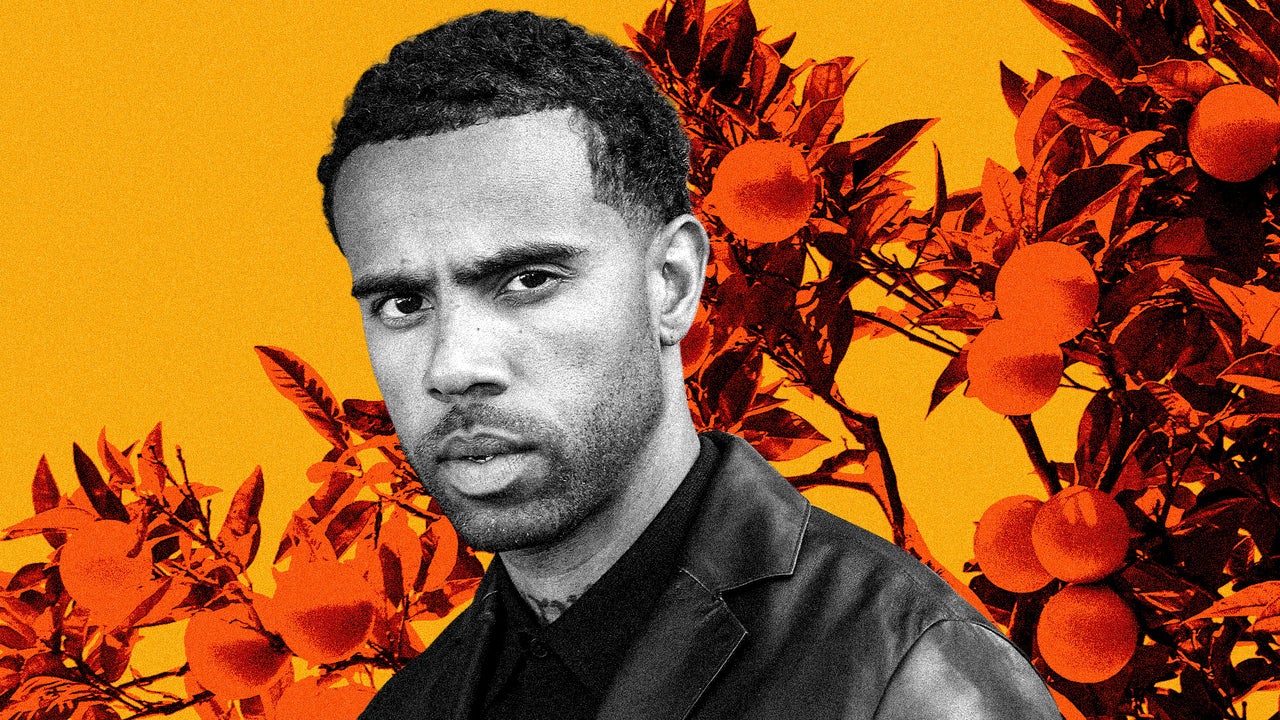
Quick, what’s the first thing that comes to mind when you picture an orange tree? If the response is “Vic Mensa’s backyard,” congratulations. You’re likely unusually attuned to social justice and an internet savant to boot.
For the uninitiated, Vic Mensa is a rapper-turned-activist known lately for his stream of consciousness video monologues dubbed the “Orange Tree” series. In the videos, Mensa muses over modern historical political issues plaguing the American public as well as his personal life, delivered in a way that makes viewers feel as though he is speaking directly to them.
While earnest and measured, he does not shy away from sharing personal opinions and refuses to self-censor, all the while peeling an orange plucked from his backyard orange tree.
Video topics run the gamut—the ramifications of slavery, Palestine, fatherhood, the World Cup—and have racked up millions of views. They’ve also cost Mensa opportunities, he says, because of “speaking his mind and talking to people in a genuine way.”
After winning the attention of social media, Mensa went on to win a Webby Award in the People’s Voice category.
To understand why Mensa’s videos gained significant traction at a time when the internet is oversaturated with content, one must understand today’s political climate and its intersection with the chronically online.
He addresses an American public disillusioned by the government and traditional media, exhausted by AI proponents refusing to reckon with its harms, and worn down by climate disaster, layoffs, and war after war—while quite literally watching the fabric of society come apart.
In posting these videos, Mensa joins the ranks of other celebrities who have dedicated their platforms to social justice awareness, such as children’s YouTube educator Ms. Rachel, actress Hannah Einbeinder, and actor-director Mark Ruffalo.
When asked about how he builds trust with his audience, Mensa points to an inclination to be vulnerable and honest, especially about his own experiences.
“I just try to be a man of integrity,” he tells Fast Company. “There are certain things that will come to me—endorsements and advertisers—that are just antithetical to what I believe . . . and I don’t take the money. I’m sure I would damage trust if I took the money, but I also would lack integrity.”
Mensa’s unfiltered coverage and nuanced takes eventually led to the recent launch of The Vic Mensa Show, a planned continuation of raw, authentic conversations, but this time featuring guests.
It is a video podcast “where artists, thinkers and cultural figures talk about what freedom actually costs,” according to his website.
Mensa recently stopped by Fast Company’s office in New York City to unpack the journey behind the viral series, the newly launched show, and his creative process.
This interview has been edited and condensed for brevity.
On creating the “Orange Tree” series
I have an orange tree in my backyard and [it] became an exercise in writing, communication, comedy, political, historical research, and cinematography.
It’s definitely a passion project. . . . Something I have learned from that is, sometimes the painting that the artist creates for love of his work is the greatest one.
[There are times in] this life when you do things without knowing where it may lead and without necessarily even a commercial viability, but just to express yourself and out of inspiration with a pure inspiration—that you may stumble on something great.
On figuring out where to start
To begin unprepared is better than to have never started at all. And it’s okay to learn on the job when you’re working for yourself.
First, I was doing these videos just in my car on an iPhone. . . . I was like, man, this shit looks like ass. It doesn’t fulfill me creatively. Ideologically, as a voice, it’s fulfilling me, but the visual is fucked. So I got the camera . . . this is still ass. Still not good. So I bought some lights . . . maybe a little bit better, but still kind of whack.
In the process of disliking the visual product that I was creating, I was pushed to keep trying to change something. Okay, switch from [Adobe] Premiere to [Blackmagic Design] DaVinci. Learn color science to a degree. Learn how to build a node tree. Exposure, saturation, custom curves, qualifiers, all the shit.
Eventually, I figured out to use the sun as a backlight, and I kind of peeped what a key light was, and have some darkness and learn some shadows and see that the dark parts of the image give it depth and give it humanity and reality.
I did so much that I thought was whack, didn’t meet my personal creative standard . . . but learning on the job, I’ve gotten a lot better in a year’s time.
On the creative process behind episodes
I do write them. Sometimes it’s like a journal entry. One time I was talking to my therapist and I was telling her what I had started to understand about lighting—that having shadows on my face, having parts of me that are underexposed and maybe completely dark actually was progressing my image.
And that it felt like a metaphor for life . . . when you can properly utilize moments of darkness interplayed with enlightenment, you get a full picture of a person. She was, like, “That’s a good one.” And I was, like, “I should go do an Orange Tree about that.”
Sometimes I write them while I’m pushing the baby around in a stroller. That’s a good time to write. Driving is a good time to write.
The way I look at turning something that is a larger idea into a small digestible format is most often I write a joke. I identify a premise and perhaps a perspective, maybe a contradiction, and I look for a joke. . . . A lot of this shit is actually too ridiculo