Async GRPO with LoRA across HF Jobs: a bucket, a proxy, and no NCCL
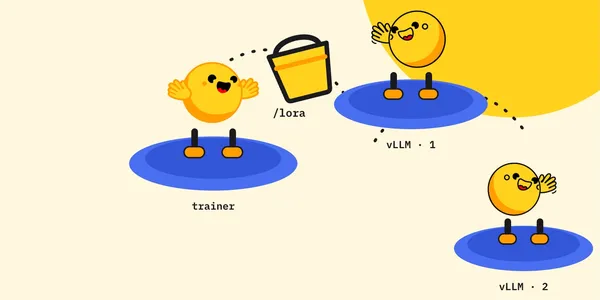
Async GRPO with LoRA across HF Jobs: a bucket, a proxy, and no NCCL

TL;DRAsyncGRPOTrainercan now train a LoRA adapter and sync only that adapter to vLLM (TRL v1.14).A rank-1 adapter is a few megabytes, so it can travel through a Storage Bucket mounted in every Job instead of over NCCL. The trainer and the vLLM replicas run as separate Hugging Face Jobs on separate machines. A small proxy in front of the replicas adds the auth header, routes each rollout to the replica that already holds its KV prefix, and broadcasts adapter loads to every replica. The AsyncGRPO metrics show where the bottleneck sits. Five runs take the same recipe from 3 h 27 min to 53 min for 500 steps.
LoRA support recently landed in TRL's AsyncGRPOTrainer
with PR #7017, and ships with TRL v1.14. The asynchronous trainer can now train an adapter instead of the full model, and it syncs only the LoRA adapter to vLLM. This post covers a real-world project built on top of it, where training and inference no longer share a machine.
LoRA training is particularly suited for RL, as shown in Thinking Machines's blog LoRA Without Regret. They show that LoRA can match full fine-tuning for policy-gradient RL, even with rank 1. This stems from the fact that the advantage function only gives
~O(1)bits of information per episode, so there is not that much to learn from each step, from a total-bits-of-information point of view. A rank-1 adapter has enough capacity to absorb it.
There is also a systems consequence of LoRA training. A rank-1 adapter for a 1.5B model is a few megabytes, while the full model is around 3 GB. Instead of sending the full policy to the inference workers after every update, we can just send the adapter. vLLM can also keep several adapters loaded at once. Old rollouts finish with the policy they started with, while new rollouts use the latest one.
TRL's
AsyncGRPOTraineralready separates training and generation. The trainer and vLLM can run on different machines and at their own speed. This is easy in a single-node or cluster setting where both processes share a filesystem or can form an NCCL group.
What we want is to run the same setup with Hugging Face Jobs. Essentially, an HF Job is one container running on one VM. This means that one Job cannot spawn multiple nodes (at least for now) to hold a trainer and a fleet of vLLM servers (we are limited to 8xH200 at most per node). The
AsyncGRPOTraineris built for exactly that kind of scale, so the question became: how far can we get if we drop the requirement that the trainer and the inference servers share a node?
Well, with a full-weight sync, the answer would be "not far". Every update would have to move gigabytes between machines, which is what NCCL is for in a dense cluster, but Jobs can't communicate across nodes. There is no shared local disk and obviously no shared
localhost. With LoRA, a sync is only a few megabytes. For the filesystem part, HF Jobs provide volumes backed by Storage Buckets! These buckets can then be mounted as a FUSE filesystem in every Job and are enough to work as a shared FS between nodes. No network path between the Jobs is needed at all.
The setup ended up being quite small:
- a trainer Job running
AsyncGRPOTrainer
with LoRA (and FSDP, more on that later), - two vLLM Jobs, each serving the base model plus whatever adapter the trainer last published,
- a Storage Bucket mounted in all three at the same path, which is how the adapter gets from the trainer to the servers,
- a proxy server. We'll dive deeper into why we need one, but at a high level we need a proxy that routes each rollout to the replica most likely to hold its KV cache, and broadcasts every adapter update to all vLLM replicas.
The architecture: leveraging Hugging Face Jobs and Storage Buckets 🪣
The new adapter-only sync path in
AsyncGRPOTrainerworks like this. The trainer does not send tensors to vLLM. Every few optimizer steps, it saves the adapter under
<output_dir>/.vllm_lora/trl-policy-v{N}, publishes the directory with an atomic rename, then sends its path to vLLM's /v1/load_lora_adapterendpoint. vLLM loads the files from disk, so the rollout worker can then request
model="trl-policy-v{N}".This is how runtime adapter loading already works in vLLM. The endpoint takes a path, not tensors, so the trainer and the server are expected to share a filesystem. On a Slurm cluster, that is the network filesystem. On Jobs, we get the same thing by mounting a Storage Bucket as a volume at the same path in every Job, as we mentioned earlier. Under the hood, it uses hf-mount
, which exposes the bucket as a POSIX filesystem inside the container:
# every Job gets the same bucket at the same absolute path
hf jobs run ... -v hf://buckets/aminediroHF/asyncgrpo-lora-buckets:/lora ...
Nothing in TRL or vLLM had to change for this. The trainer writes to
/lora/<run>/.vllm_lora/and the servers read from the same path. The path sent in the POST request is already valid inside every container.

Note that we also store the checkpoints and the final adapter in the bucket. The HF Jobs are ephemeral, but a preempted trainer can resume training, as the final adapter is always persisted to the bucket and is never lost when the Job stops.
The three Jobs
The vLLM replicas
Each replica uses one GPU and the stock
vllm/vllm-openaiimage. We only need to enable runtime LoRA loading and reserve enough adapter slots.
The number of adapter slots follows from
max_staleness. In
AsyncGRPOTrainer, every weight sync bumps the policy version by one, and
max_stalenessis how many versions a rollout sample may lag behind the current policy before the trainer discards it. With
max_staleness=4, a sample generated under
trl-policy-v3is still used for training while the trainer is at
v7. A rollout that started under
v3must also be able to finish under
v3. So at any moment, vLLM has to serve the current policy plus the four before it. That is why the trainer keeps
max_staleness + 1adapter versions registered and unloads anything older. Each sync loads the new version before it unloads the oldest one, which needs one more slot during the swap. That gives
--max-loras 6. With only five, vLLM would silently evict a policy that still has rollouts in flight at every sync.
# --expose 8000                       reachable at https://<job_id>--8000.hf.jobs
# -v ...:/lora:ro                     read-only: the server only reads adapters
# VLLM_ALLOW_RUNTIME_LORA_UPDATING=1  enables /v1/load_lora_adapter
# VLLM_SERVER_DEV_MODE=1              enables /pause, /resume, /server_info (TRL needs all three)
# --max-loras 6                       max_staleness=4 -> 4+2 adapter slots
for replica in 1 2; do
hf jobs run --detach --flavor h200 --timeout 8h --secrets HF_TOKEN \
    --expose 8000 \
    -v "hf://buckets/${BUCKET}:/lora:ro" \
    -e VLLM_ALLOW_RUNTIME_LORA_UPDATING=1 \
    -e VLLM_SERVER_DEV_MODE=1 \
    -- vllm/vllm-openai:v0.27.1 \
    vllm serve Qwen/Qwen2.5-Math-1.5B --host 0.0.0.0 --port 8000 \
        --max-model-len 4096 --logprobs-mode processed_logprobs --generation-config vllm \
        --enable-lora --max-lora-rank 1 --max-loras 6
done
We pin vLLM to
v0.27.1. vLLM moves fast, and the flags above and the runtime LoRA endpoints are the ones that version exposes, so treat the version as part of the recipe.
There is another possible design where the trainer keeps only the latest adapter and always publishes it under the same name. We did not go that way, because vLLM keys its prefix cache by adapter name. With a single name, KV blocks computed under the previous weights would still match after the swap, so the prefill would not be redone and a rollout could get its prefix from one policy version and its decode from the next. The trainer would have no way to tell, and it would show up as
ratiodrifting away from 1. Versioned names make this impossible: a name always means one set of weights, and a cached prefix can never match a newer version.
The dataset choice: the Sanity set
We chose sail/Sanity-Test-R1D-1.5B
, the dataset from Defeating the Training-Inference Mismatch via FP16 (Qi et al., 2025). The reproduction code is in sail-sg/Precision-RL
.
The authors generated 40 answers for each MATH problem with DeepSeek-R1-Distill-Qwen-1.5B. They kept problems with a success rate between 20% and 80%, yielding 1,460 questions. This dataset is really good for RL validation because the questions are neither already solved nor completely hopeless for that model, meaning the model can get a good early signal to train on and improve.
This is awesome as a robust end-to-end test: if one vLLM replica silently serves the base model under an adapter name, we want to see that in the curve within a few dozen steps. Also, this dataset is small enough to cycle through in less than two hours.
We also take the hyperparameters from the paper's LoRA scripts in oat/scripts/lora
:
Qwen/Qwen2.5-Math-1.5B, LoRA rank 1 with alpha 2, a learning rate of 4e-5, 8 samples per prompt, 128 completions per step, a maximum of 3,000 generated tokens and a 4,096-token context.
The trainer
The trainer uses the same
vllm/vllm-openai:v0.27.1image with TRL installed on top. We ran the PR branch at the time; the same code now ships in TRL v1.14. The training script is a normal
AsyncGRPOTrainerscript. The only Job-specific values are the output directory and the server URL.
from peft import LoraConfig
from trl.experimental.async_grpo import AsyncGRPOConfig, AsyncGRPOTrainer

config = AsyncGRPOConfig(
    output_dir="/lora/sanity-lora-r1",       # on the bucket: adapters, checkpoints and the final adapter all land here
    vllm_server_base_url="http://localhost:8000",   # the proxy, not a vLLM Job; TRL never sees the Jobs URLs
    max_staleness=4,
    weight_sync_steps=4,                     # publish an adapter every 4 optimizer steps
    save_strategy="steps", save_steps=50,    # checkpoints go to the same bucket -> resume after preemption
    ...
)
trainer = AsyncGRPOTrainer(
    model="Qwen/Qwen2.5-Math-1.5B",
    args=config,
    peft_config=LoraConfig(r=1, lora_alpha=2, target_modules="all-linear"),  # plain LoRA vLLM can serve as-is
    ...
)
During initialization, TRL calls
/server_info. If it finds alora_config, it uses adapter-only sync. Configurations vLLM cannot serve directly, such as DoRA,modules_to_save, or a rank above--max-lora-rank, fall back to merged-weight sync with a warning. The log should containAdapter-only vLLM sync enabled.
The proxy
Now onto the fun stuff. We need a proxy between the trainer and the vLLM Jobs for two reasons:
Exposed Job ports require an
Authorization: Bearer <HF token>
header on every request. The proxy is where that header gets added, so TRL does not need to know about it.We want more than one GPU generating. On a single vLLM server, the usual way to get that is
--data-parallel-size > 1
, but TRL refuses adapter-only sync in that mode, for a good reason: a call to/v1/load_lora_adapter
only reaches the DP rank that answers it, so the other ranks would keep serving the base model under the new policy name. On Jobs the question does not even arise, since each replica is its own machine. So the data parallelism has to live one level up, in something that fans the adapter load out to every replica.
We therefore run a small proxy at
127.0.0.1:8000on the trainer Job and point TRL to it as if it were a single vLLM server. Besides adding the header, the proxy does two things functionally:
- It sends each completion request to one replica, chosen so that the eight rollouts of a prompt land where their prefix is already cached (details on this below).
- It broadcasts every state-changing request, such as adapter loads, pause and resume, to all replicas, so that a policy name means the same thing everywhere.
Routing rollouts by KV prefix
A quick reminder of why this matters. Generating a completion has two phases with very different workload profiles:</