Monsanto's Cruel, and Dangerous, Monopolization on American Farming (2008)
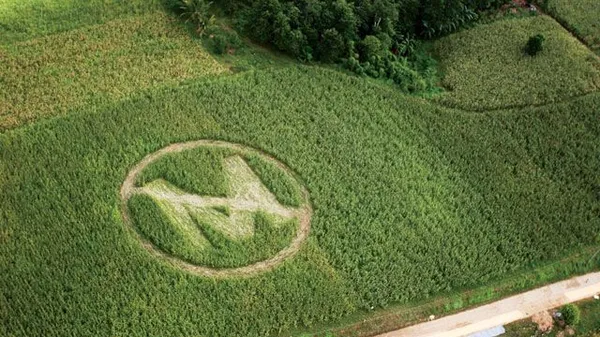
The Square Deal is a fixture in Eagleville, a place where farmers and townspeople can go for lightbulbs, greeting cards, hunting gear, ice cream, aspirin, and dozens of other small items without having to drive to a big-box store in Bethany, the county seat, 15 miles down Interstate 35. Everyone knows Rinehart, who was born and raised in the area and runs one of Eagleville’s few surviving businesses. The stranger came up to the counter and asked for him by name. “Well, that’s me,” said Rinehart. As Rinehart would recall, the man began verbally attacking him, saying he had proof that Rinehart had planted Monsanto’s genetically modified (G.M.) soybeans in violation of the company’s patent. Better come clean and settle with Monsanto, Rinehart says the man told him—or face the consequences. Rinehart was incredulous, listening to the words as puzzled customers and employees looked on. Like many others in rural America, Rinehart knew of Monsanto’s fierce reputation for enforcing its patents and suing anyone who allegedly violated them. But Rinehart wasn’t a farmer. He wasn’t a seed dealer. He hadn’t planted any seeds or sold any seeds. He owned a small—a really small—country store in a town of 350 people. He was angry that somebody could just barge into the store and embarrass him in front of everyone. “It made me and my business look bad,” he says. Rinehart says he told the intruder, “You got the wrong guy.” When the stranger persisted, Rinehart showed him the door. On the way out the man kept making threats. Rinehart says he can’t remember the exact words, but they were to the effect of: “Monsanto is big. You can’t win. We will get you. You will pay.” Scenes like this are playing out in many parts of rural America these days as Monsanto goes after farmers, farmers’ co-ops, seed dealers—anyone it suspects may have infringed its patents of genetically modified seeds. As interviews and reams of court documents reveal, Monsanto relies on a shadowy army of private investigators and agents in the American heartland to strike fear into farm country. They fan out into fields and farm towns, where they secretly videotape and photograph farmers, store owners, and co-ops; infiltrate community meetings; and gather information from informants about farming activities. Farmers say that some Monsanto agents pretend to be surveyors. Others confront farmers on their land and try to pressure them to sign papers giving Monsanto access to their private records. Farmers call them the “seed police” and use words such as “Gestapo” and “Mafia” to describe their tactics. When asked about these practices, Monsanto declined to comment specifically, other than to say that the company is simply protecting its patents. “Monsanto spends more than $2 million a day in research to identify, test, develop and bring to market innovative new seeds and technologies that benefit farmers,” Monsanto spokesman Darren Wallis wrote in an e-mailed letter to Vanity Fair. “One tool in protecting this investment is patenting our discoveries and, if necessary, legally defending those patents against those who might choose to infringe upon them.” Wallis said that, while the vast majority of farmers and seed dealers follow the licensing agreements, “a tiny fraction” do not, and that Monsanto is obligated to those who do abide by its rules to enforce its patent rights on those who “reap the benefits of the technology without paying for its use.” He said only a small number of cases ever go to trial. Some compare Monsanto’s hard-line approach to Microsoft’s zealous efforts to protect its software from pirates. At least with Microsoft the buyer of a program can use it over and over again. But farmers who buy Monsanto’s seeds can’t even do that. The Control of Nature Monsanto developed G.M. seeds that would resist its own herbicide, Roundup, offering farmers a convenient way to spray fields with weed killer without affecting crops. Monsanto then patented the seeds. For nearly all of its history the United States Patent and Trademark Office had refused to grant patents on seeds, viewing them as life-forms with too many variables to be patented. “It’s not like describing a widget,” says Joseph Mendelson III, the legal director of the Center for Food Safety, which has tracked Monsanto’s activities in rural America for years. Indeed not. But in 1980 the U.S. Supreme Court, in a five-to-four decision, turned seeds into widgets, laying the groundwork for a handful of corporations to begin taking control of the world’s food supply. In its decision, the court extended patent law to cover “a live human-made microorganism.” In this case, the organism wasn’t even a seed. Rather, it was a Pseudomonas bacterium developed by a General Electric scientist to clean up oil spills. But the precedent was set, and Monsanto took advantage of it. Since the 1980s, Monsanto has become the world leader in genetic modification of seeds and has won 674 biotechnology patents, more than any other company, according to U.S. Department of Agriculture data. Farmers who buy Monsanto’s patented Roundup Ready seeds are required to sign an agreement promising not to save the seed produced after each harvest for re-planting, or to sell the seed to other farmers. This means that farmers must buy new seed every year. Those increased sales, coupled with ballooning sales of its Roundup weed killer, have been a bonanza for Monsanto. This radical departure from age-old practice has created turmoil in farm country. Some farmers don’t fully understand that they aren’t supposed to save Monsanto’s seeds for next year’s planting. Others do, but ignore the stipulation rather than throw away a perfectly usable product. Still others say that they don’t use Monsanto’s genetically modified seeds, but seeds have been blown into their fields by wind or deposited by birds. It’s certainly easy for G.M. seeds to get mixed in with traditional varieties when seeds are cleaned by commercial dealers for re-planting. The seeds look identical; only a laboratory analysis can show the difference. Even if a farmer doesn’t buy G.M. seeds and doesn’t want them on his land, it’s a safe bet he’ll get a visit from Monsanto’s seed police if crops grown from G.M. seeds are discovered in his fields. Most Americans know Monsanto because of what it sells to put on our lawns— the ubiquitous weed killer Roundup. What they may not know is that the company now profoundly influences—and one day may virtually control—what we put on our tables. For most of its history Monsanto was a chemical giant, producing some of the most toxic substances ever created, residues from which have left us with some of the most polluted sites on earth. Yet in a little more than a decade, the company has sought to shed its polluted past and morph into something much different and more far-reaching—an “agricultural company” dedicated to making the world “a better place for future generations.” Still, more than one Web log claims to see similarities between Monsanto and the fictional company “U-North” in the movie Michael Clayton, an agribusiness giant accused in a multibillion-dollar lawsuit of selling an herbicide that causes cancer. Monsanto’s genetically modified seeds have transformed the company and are radically altering global agriculture. So far, the company has produced G.M. seeds for soybeans, corn, canola, and cotton. Many more products have been developed or are in the pipeline, including seeds for sugar beets and alfalfa. The company is also seeking to extend its reach into milk production by marketing an artificial growth hormone for cows that increases their output, and it is taking aggressive steps to put those who don’t want to use growth hormone at a commercial disadvantage. Even as the company is pushing its G.M. agenda, Monsanto is buying up conventional-seed companies. In 2005, Monsanto paid $1.4 billion for Seminis, which controlled 40 percent of the U.S. market for lettuce, tomatoes, and other vegetable and fruit seeds. Two weeks later it announced the acquisition of the country’s third-largest cottonseed company, Emergent Genetics, for $300 million. It’s estimated that Monsanto seeds now account for 90 percent of the U.S. production of soybeans, which are used in food products beyond counting. Monsanto’s acquisitions have fueled explosive growth, transforming the St. Louis–based corporation into the largest seed company in the world. In Iraq, the groundwork has been laid to protect the patents of Monsanto and other G.M.-seed companies. One of L. Paul Bremer’s last acts as head of the Coalition Provisional Authority was an order stipulating that “farmers shall be prohibited from re-using seeds of protected varieties.” Monsanto has said that it has no interest in doing business in Iraq, but should the company change its mind, the American-style law is in place. To be sure, more and more agricultural corporations and individual farmers are using Monsanto’s G.M. seeds. As recently as 1980, no genetically modified crops were grown in the U.S. In 2007, the total was 142 million acres planted. Worldwide, the figure was 282 million acres. Many farmers believe that G.M. seeds increase crop yields and save money. Another reason for their attraction is convenience. By using Roundup Ready soybean seeds, a farmer can spend less time tending to his fields. With Monsanto seeds, a farmer plants his crop, then treats it later with Roundup to kill weeds. That takes the place of labor-intensive weed control and plowing. Monsanto portrays its move into G.M. seeds as a giant leap for mankind. But out in the American countryside, Monsanto’s no-holds-barred tactics have made it feared and loathed. Like it or not, farmers say, they have fewer and fewer choices in buying seeds. And controlling the seeds is not some abstraction. Whoever provides the world’s seeds controls the world’s food supply. Under Surveillance During the 2002 growing season, Investigator Jeffery Moore, through surveillance of Mr. Rinehart’s farm facility and farming operations, observed Defendant planting brown bag soybean seed. Mr. Moore observed the Defendant take the brown bag soybeans to a field, which was subsequently loaded into a grain drill and planted. Mr. Moore located two empty bags in the ditch in the public road right-of-way beside one of the fields planted by Rinehart, which contained some soybeans. Mr. Moore collected a small amount of soybeans left in the bags which Defendant had tossed into the public right-of way. These samples tested positive for Monsanto’s Roundup Ready technology. Faced with a federal lawsuit, Rinehart had to hire a lawyer. Monsanto eventually realized that “Investigator Jeffery Moore” had targeted the wrong man, and dropped the suit. Rinehart later learned that the company had been secretly investigating farmers in his area. Rinehart never heard from Monsanto again: no letter of apology, no public concession that the company had made a terrible mistake, no offer to pay his attorney’s fees. “I don’t know how they get away with it,” he says. “If I tried to do something like that it would be bad news. I felt like I was in another country.” Gary Rinehart is actually one of Monsanto’s luckier targets. Ever since commercial introduction of its G.M. seeds, in 1996, Monsanto has launched thousands of investigations and filed lawsuits against hundreds of farmers and seed dealers. In a 2007 report, the Center for Food Safety, in Washington, D.C., documented 112 such lawsuits, in 27 states. Even more significant, in the Center’s opinion, are the numbers of farmers who settle because they don’t have the money or the time to fight Monsanto. “The number of cases filed is only the tip of the iceberg,” says Bill Freese, the Center’s science-policy analyst. Freese says he has been told of many cases in which Monsanto investigators showed up at a farmer’s house or confronted him in his fields, claiming he had violated the technology agreement and demanding to see his records. According to Freese, investigators will say, “Monsanto knows that you are saving Roundup Ready seeds, and if you don’t sign these information-release forms, Monsanto is going to come after you and take your farm or take you for all you’re worth.” Investigators will sometimes show a farmer a photo of himself coming out of a store, to let him know he is being followed. Lawyers who have represented farmers sued by Monsanto say that intimidating actions like these are commonplace. Most give in and pay Monsanto some amount in damages; those who resist face the full force of Monsanto’s legal wrath. Scorched-Earth Tactics In the fall of 2006, Monsanto trained its legal guns on Pilot Grove; ever since, its farmers have been drawn into a costly, disruptive legal battle against an opponent with limitless resources. Neither Pilot Grove nor Monsanto will discuss the case, but it is possible to piece together much of the story from documents filed as part of the litigation. Monsanto began investigating soybean farmers in and around Pilot Grove several years ago. There is no indication as to what sparked the probe, but Monsanto periodically investigates farmers in soybean-growing regions such as this one in central Missouri. The company has a staff devoted to enforcing patents and litigating against farmers. To gather leads, the company maintains an 800 number and encourages farmers to inform on other farmers they think may be engaging in “seed piracy.” Once Pilot Grove had been targeted, Monsanto sent private investigators into the area. Over a period of months, Monsanto’s investigators surreptitiously followed the co-op’s employees and customers and videotaped them in fields and going about other activities. At least 17 such surveillance videos were made, according to court records. The investigative work was outsourced to a St. Louis agency, McDowell & Associates. It was a McDowell investigator who erroneously fingered Gary Rinehart. In Pilot Grove, at least 11 McDowell investigators have worked the case, and Monsanto makes no bones about the extent of this effort: “Surveillance was conducted throughout the year by various investigators in the field,” according to court records. McDowell, like Monsanto, will not comment on the case. Not long after investigators showed up in Pilot Grove, Monsanto subpoenaed the co-op’s records concerning seed and herbicide purchases and seed-cleaning operations. The co-op provided more than 800 pages of documents pertaining to dozens of farmers. Monsanto sued two farmers and negotiated settlements with more than 25 others it accused of seed piracy. But Monsanto’s legal assault had only begun. Although the co-op had provided voluminous records, Monsanto then sued it in federal court for patent infringement. Monsanto contended that by cleaning seeds—a service which it had provided for decades—the co-op was inducing farmers to violate Monsanto’s patents. In effect, Monsanto wanted the co-op to police its own customers. In the majority of cases where Monsanto sues, or threatens to sue, farmers settle before going to trial. The cost and stress of litigating against a global corporation are just too great. But Pilot Grove wouldn’t cave—and ever since, Monsanto has been turning up the heat. The more the co-op has resisted, the more legal firepower Monsanto has aimed at it. Pilot Grove’s lawyer, Steven H. Schwartz, described Monsanto in a court filing as pursuing a “scorched earth tactic,” intent on “trying to drive the co-op into the ground.” Even after Pilot Grove turned over thousands more pages of sales records going back five years, and covering virtually every one of its farmer customers, Monsanto wanted more—the right to inspect the co-op’s hard drives. When the co-op offered to provide an electronic version of any record, Monsanto demanded hands-on access to Pilot Grove’s in-house computers. Monsanto next petitioned to make potential damages punitive—tripling the