Who we become when we talk to machines
Brian, a middle-aged financial consultant, spends his day sitting in front of three screens. Two of them involve his job. The third features a chatbot, which he has given a woman’s name and frequently uses. Brian spent years on the road for work earlier in his career, has never married, and recently broke up with a woman who said he was emotionally unavailable. What did Brian do, in response? He asked the chatbot if the woman had a point.
“It’s an extraordinary moment,” writes MIT Professor Sherry Turkle, who interviewed Brian (not his real name) while conducting her research for her new book about chatbots. “Brian asks an object with no emotions to tell him if he is emotionally withholding: ‘Speak to me about what you cannot experience.’ As soon as he asks the program to talk about intimacy, he’s asking it to punch above its weight.”
And yet, this kind of thing seems to be happening a lot today.
“People think the empathy of a machine is what empathy is, then turn away from the people in their lives because they’re not empathetic enough,” Turkle says. “We’re getting ourselves in a position where human beings are too much work, right at the moment when we have never needed other people more.”
After all, what is a chatbot? It’s a computer program predicting the most plausible next string of text in a conversation, based on massive amounts of data fed into it.
“What a chatbot does is offer pretend empathy,” Turkle says. “After it tells you how much it loves you and how much it understands you, it doesn’t care if you kill yourself or cook some pasta.”
Sadly, chatbots have in fact been associated with high-profile cases of teen suicide as well, sometimes after teens get drawn into extensive dialogues with chat tools.
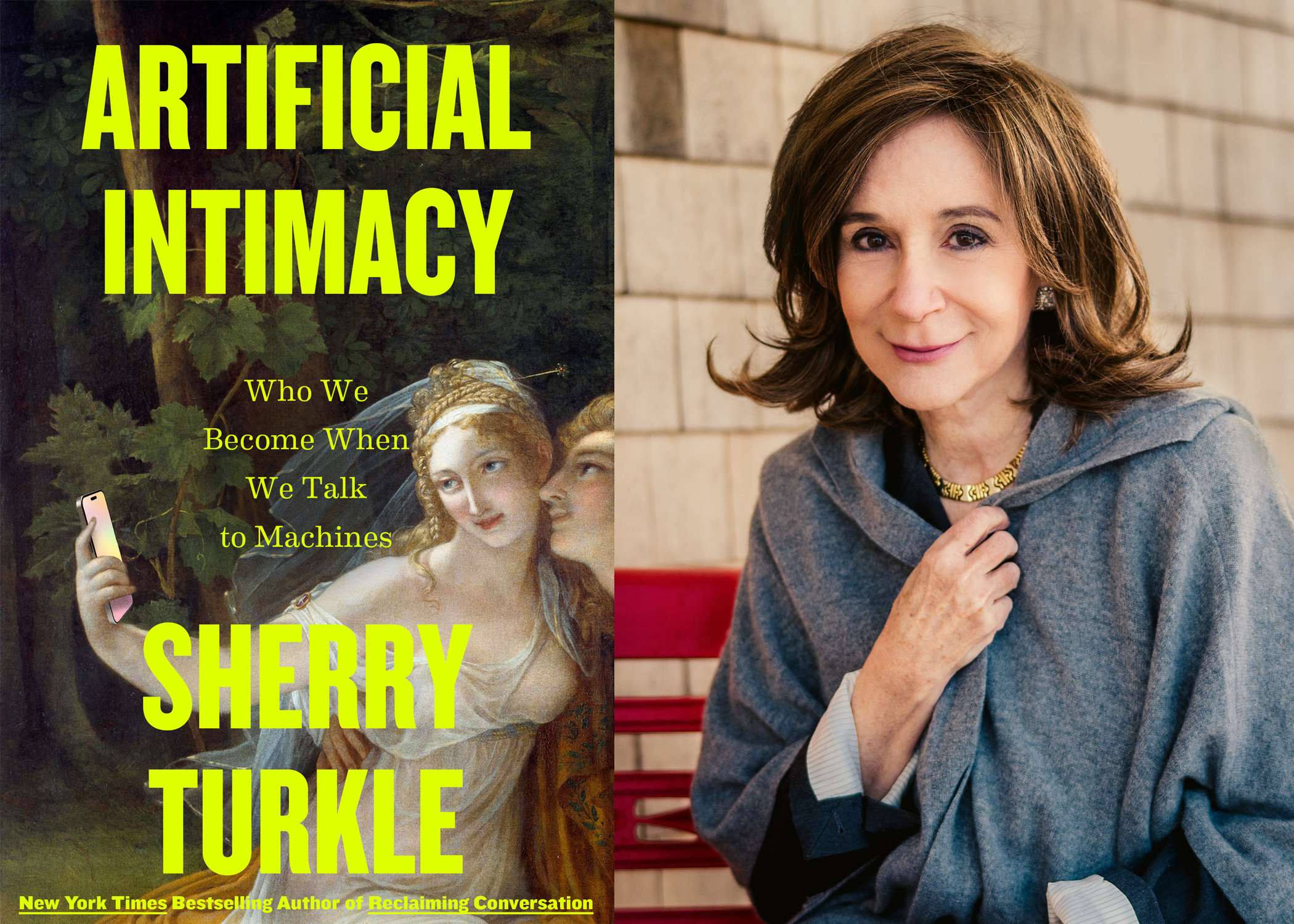
Turkle explores this terrain in a new book, “Artificial Intimacy: Who We Become When We Talk to Machines,” published today by Little, Brown and Company. After surveying evidence and conducting new research, she emphatically concludes that chatbot use, while it may often feel like a short-term salve, is broadly detrimental in terms of human development and social connectivity.
“We’re doing ourselves a tremendous disservice at every moment in the life cycle,” says Turkle, the Abby Rockefeller Mauzé Professor of the Social Studies of Science and Technology at MIT.
The inner history of technology
A sociologist and clinical psychologist by training, Turkle is a longtime faculty member in MIT’s Program in Science, Technology, and Society. In books such as “The Second Self” (1984), “Life on the Screen” (1997), and “Alone Together” (2011), she has evaluated the interplay of technology, psychology, and personal identity. In “Reclaiming Conversation” (2015), she documented the costs of texting and using social media.
“I feel the story I’m telling is the inner history of technology,” Turkle says. “Not just what it does, but what it does to people.”
Turkle structures “Artificial Intimacy” around the stages of a human life and explores the implications of chatbots for each one. In her interviews with children, Turkle finds a persistent blurring of the line between chatbots, people, and other devices.
One 8-year-old uses the same phone to talk to their grandparents and to ChatGPT, regarding them all as “things you reach on your phone.” A weary graduate-student mother who uses a chatbot for bedtime stories says her daughter thinks the chatbot is “a person in the phone, absolutely.”
In this sense, chatbots may be interfering with even the most basic childhood processes of distinguishing people from inanimate objects. Turkle finds many additional problems with the use of chatbots as ever-present entertainment for children, noting that a certain amount of time alone helps the development of imagination and inner resources.
“Children can’t learn trust from a device that not only lies but doesn’t know when it lies,” Turkle writes. “They can’t develop the capacity for solitude that enables both a sense of self and the capacity for mutuality.”
All told, in affecting the ability of children to develop, the dangers of chatbots are “existential,” Turkle believes.
Facing reality, but understanding the appeal
Adults don’t fare much better when they use chatbots heavily, Turkle says. “Artificial Intimacy” explores case after case of grown-ups who become dependent on chatbots as well: people going through divorces or estrangements who want dialogue, students looking for advice about applying to college or graduate school, workers who enlist ChatGPT to do assignments, and more. They start using chatbots, keep using chatbots, and before long seem less interested in human interaction, and less capable of it.
“Once people are involved with a connection with a robot, they start to think that it’s alive, that it cares about them, that it loves them,” Turkle says.
That means people can lose or fail to build their own capacities for new thought, and opt out of dealing with the real world in all its maddening-but-affirming complexity.
“We’re de-skilling ourselves as relational beings,” Turkle says. “We’re also de-skilling ourselves in work. We’re de-skilling ourselves in personal relationships. It’s across the board.” And speaking of a practice multiple people in the book have attempted, she says, “When we build chatbot avatars of dead relatives to keep them alive, we can lose our ability to mourn.”
We are not, in her estimation, doing the hard work of figuring other people out, seeing things from different points of view, and putting in the effort to build on those things and make society better.
“We’re starting to define being human as not doing the work,” Turkle says.
For all of that, a considerable amount of “Artificial Intimacy” involves understanding why people engage with chatbots. After all, as Turkle writes in the book, “Chatbots always agree with us and affirm us. They always offer us their full, undivided attention.” And once that happens, things seem to just go from there.
People, meanwhile, can be prickly, demanding, and moody. As Turkle says: “People say they prefer the chatbot because their husband or wife says, ‘Dear, you took out the garbage, but also do the dishes, and clean up the kitchen while you’re at it.’ And a chatbot just says, ‘Oh, you’re so wonderful.’”
She adds: “This technology is offering something people really want, which is to feel less vulnerable. And it offers it over and over again. You don’t want to have to ask somebody out? Don’t want to offer condolences? At every opportunity, technology says, ‘Why don’t you do this thing that’s less hard.’”
And as Turkle acknowledges in the book, there is a shortage of services such as mental health care providers in the U.S., where only about half of people have access to one, according to a federal government study she cites. Chatbots are helping to fill this void, for better or worse.
Don’t fear the friction
Turkle also notes that the age of social media has likely led people to have fewer in-person friendships and interactions, a problem that chatbots are now aiming to address.
“You take away people’s capacities, then you offer technology as the cure for the problems technology caused in the first place,” Turkle says.
In light of all this, given Turkle’s dim view of chatbots amid the spread of AI, what is actually to be done to restore human interaction? For starters, Turkle thinks, we need to face up to the idea that life is not frictionless — and that’s okay.
“Everything in the life cycle is about facing up to friction and