A new California museum is a beautiful and complicated ode to the Eameses
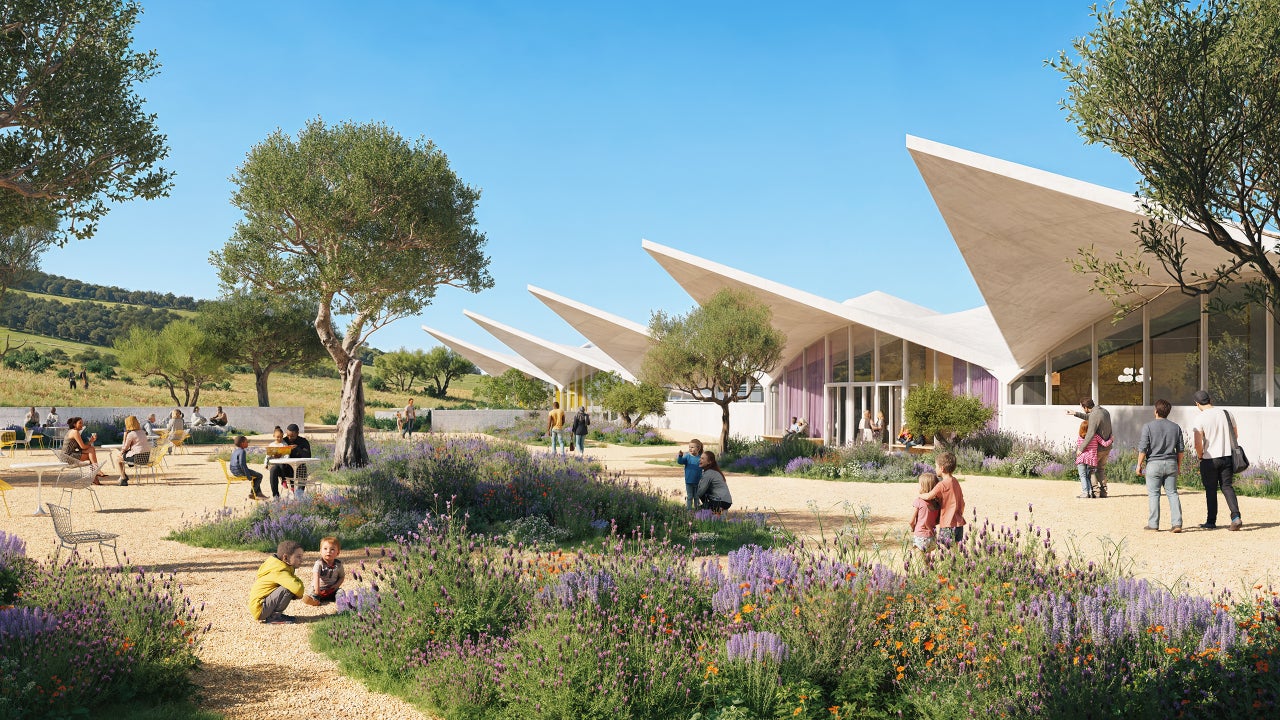
When the Eames Institute of Infinite Curiosity released renderings of its new museum last week, it aimed to show how a museum campus could encapsulate the legacy of the 20th century’s most famous design couple, Charles and Ray Eames. The architectural project—helmed by museum design heavyweight Herzog & de Meuron, along with local firm EHDD and landscape architecture firm Field Operations—is meant to be more a celebration of the Eameses’ philosophies and ideas than an Eames theme park.
“We try to ask as frequently as possible, ‘What can only happen here?’” says John Cary, the institute’s founding president and CEO.
The institute, a nonprofit charity founded in 2019 to advance the legacy of Ray and Charles, joins an existing constellation of entities dedicated to the couple’s work, including the Eames Foundation (established in 2004) and the Eames Office, which oversees the furniture line. The new museum design, an adaptive reuse of an 88.5-acre site in Novato, California, will transform a warehouse and office originally built in 1964.
The architectural concept is just one example of the Eames Institute seeking to channel the ideals and vision of the couple, including their “best for the most with the least” axiom, and a focus on mid-century aesthetics and the repurposing of industrial materials.
The release of the renderings has also brought up some uncomfortable recent dialogues about how someone in the institute’s orbit has—or has not—reflected what many consider the key values of the Eames name: anti-elitist, democratic design for everyone, and a fostering of international dialogue and multiculturalism.

In particular, the focus has been on Joe Gebbia, the multibillionaire Airbnb founder and early founding donor of the Eames Institute of Infinite Curiosity. Talking about his donation and relationship with the Eameses in a 2022 interview with Fast Company, Gebbia gushed about what the couple stood for and how it influenced him.
“I became enamored with their values, with their ethos: Create the best design for the most people for the least price. Democratize design for the masses,” Gebbia says. “They really left a gift for us, for the world. And the whole notion of starting the Eames Institute was to share that gift with everyone.”
In recent years, Gebbia has worked for the Trump administration as head of the National Design Studio, where his team has built out a suite of digital services for the government, including the prescription drug platform Trump RX and the America.gov AI chatbot. His political views have taken a far-right turn, particularly on social media, where he’s espoused anti-immigrant views, among others, that have alarmed people who would typically consider themselves aligned with the Eameses’ worldview—and which the institute has pointedly avoided addressing, until now.
(Architecture critic Christopher Hawthorne has been dogged about raising the question about the institute’s response to Gebbia’s statements.) Fast Company reached out to Gebbia for comment, and didn’t receive a response in advance of publication.
When asked directly about Gebbia’s role, Cary offers the first on-the-record statement, saying Gebbia is simply a donor and “an incredible supporter from day one.” Gebbia has never held a board seat and never had a staff position. According to Cary, he himself and Llisa Demetrios, chief curator at the Eames Institute (and the Eameses’ granddaughter), “guide 100% of the decision-making and programming.”
Eames philosophies come to life
Demetrios and Cary see that programming evolving as the museum continues to take shape. “We are learning by doing, we are prototyping, we are iterating,” Demetrios says. “That’s the best way to honor my grandparents.”
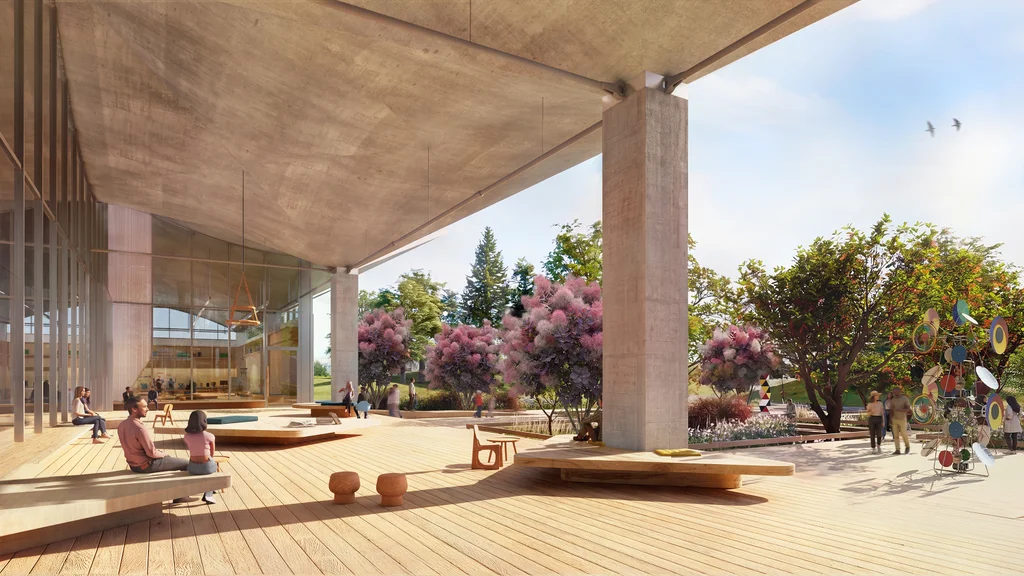
The values of the Eames, and the work that those values inspired, is central to the museum layout. References to their work are obvious in the proposed museum campus—plywood seating and a landscape scheme that alludes to the famous Powers of Ten film, for example—but the design is more grounded in the intricacies and possibilities of the site.
The museum is housed on a mid-century modern corporate campus in Marin County with a striking, crown-shaped roof that sits amid a bucolic Bay Area landscape. These new renderings, featuring a welcoming entry court and fountain, a vast central hall, a maker space, and indoor-outdoor recreation space, give a more concrete view of how the institute plans to host programming and exhibit work, including the collections of Eames furniture and other objects.
The sprawling site was once a warehouse and office space for publisher McGraw Hill, and then later owned by Birkenstock. The design of the original building was a collaboration between John Savage Bolles, who designed the publisher’s St. Louis headquarters, and Polish American architect Jan Lubicz-Nycz. Its wavy, steel-and-concrete roof is a hyperbolic paraboloid that looks like an egg carton with jagged teeth.
Cary points to research uncovering that one or both of the architects attended a 1959 University of California, Berkeley, lecture by Félix Candela, famed Mexican architect, structural engineer, and pioneer of thin-shell concrete designs, where they drew inspiration. Simon Demeuse, an architect and partner at Herzog & de Meuron, says the architects must have b
When the Eames Institute of Infinite Curiosity released renderings of its new museum last week, it aimed to show how a museum campus could encapsulate the legacy of the 20th century’s most famous design couple, Charles and Ray Eames. The architectural project—helmed by museum design heavyweight Herzog & de Meuron, along with local firm EHDD and landscape architecture firm Field Operations—is meant to be more a celebration of the Eameses’ philosophies and ideas than an Eames theme park.
“We try to ask as frequently as possible, ‘What can only happen here?’” says John Cary, the institute’s founding president and CEO.
The institute, a nonprofit charity founded in 2019 to advance the legacy of Ray and Charles, joins an existing constellation of entities dedicated to the couple’s work, including the Eames Foundation (established in 2004) and the Eames Office, which oversees the furniture line. The new museum design, an adaptive reuse of an 88.5-acre site in Novato, California, will transform a warehouse and office originally built in 1964.
The architectural concept is just one example of the Eames Institute seeking to channel the ideals and vision of the couple, including their “best for the most with the least” axiom, and a focus on mid-century aesthetics and the repurposing of industrial materials.
The release of the renderings has also brought up some uncomfortable recent dialogues about how someone in the institute’s orbit has—or has not—reflected what many consider the key values of the Eames name: anti-elitist, democratic design for everyone, and a fostering of international dialogue and multiculturalism.
In particular, the focus has been on Joe Gebbia, the multibillionaire Airbnb founder and early founding donor of the Eames Institute of Infinite Curiosity. Talking about his donation and relationship with the Eameses in a 2022 interview with Fast Company, Gebbia gushed about what the couple stood for and how it influenced him.
“I became enamored with their values, with their ethos: Create the best design for the most people for the least price. Democratize design for the masses,” Gebbia says. “They really left a gift for us, for the world. And the whole notion of starting the Eames Institute was to share that gift with everyone.”
In recent years, Gebbia has worked for the Trump administration as head of the National Design Studio, where his team has built out a suite of digital services for the government, including the prescription drug platform Trump RX and the America.gov AI chatbot. His political views have taken a far-right turn, particularly on social media, where he’s espoused anti-immigrant views, among others, that have alarmed people who would typically consider themselves aligned with the Eameses’ worldview—and which the institute has pointedly avoided addressing, until now.
(Architecture critic Christopher Hawthorne has been dogged about raising the question about the institute’s response to Gebbia’s statements.) Fast Company reached out to Gebbia for comment, and didn’t receive a response in advance of publication.
When asked directly about Gebbia’s role, Cary offers the first on-the-record statement, saying Gebbia is simply a donor and “an incredible supporter from day one.” Gebbia has never held a board seat and never had a staff position. According to Cary, he himself and Llisa Demetrios, chief curator at the Eames Institute (and the Eameses’ granddaughter), “guide 100% of the decision-making and programming.”
Eames philosophies come to life
Demetrios and Cary see that programming evolving as the museum continues to take shape. “We are learning by doing, we are prototyping, we are iterating,” Demetrios says. “That’s the best way to honor my grandparents.”
The values of the Eames, and the work that those values inspired, is central to the museum layout. References to their work are obvious in the proposed museum campus—plywood seating and a landscape scheme that alludes to the famous Powers of Ten film, for example—but the design is more grounded in the intricacies and possibilities of the site.
The museum is housed on a mid-century modern corporate campus in Marin County with a striking, crown-shaped roof that sits amid a bucolic Bay Area landscape. These new renderings, featuring a welcoming entry court and fountain, a vast central hall, a maker space, and indoor-outdoor recreation space, give a more concrete view of how the institute plans to host programming and exhibit work, including the collections of Eames furniture and other objects.
The sprawling site was once a warehouse and office space for publisher McGraw Hill, and then later owned by Birkenstock. The design of the original building was a collaboration between John Savage Bolles, who designed the publisher’s St. Louis headquarters, and Polish American architect Jan Lubicz-Nycz. Its wavy, steel-and-concrete roof is a hyperbolic paraboloid that looks like an egg carton with jagged teeth.
Cary points to research uncovering that one or both of the architects attended a 1959 University of California, Berkeley, lecture by Félix Candela, famed Mexican architect, structural engineer, and pioneer of thin-shell concrete designs, where they drew inspiration. Simon Demeuse, an architect and partner at Herzog & de Meuron, says the architects must have b