
Lecture notes on Physics Informed Neural Networks, Neural Operators, and their applications

Rent the Runway (RENT) Q2 2026 Earnings Call Transcript
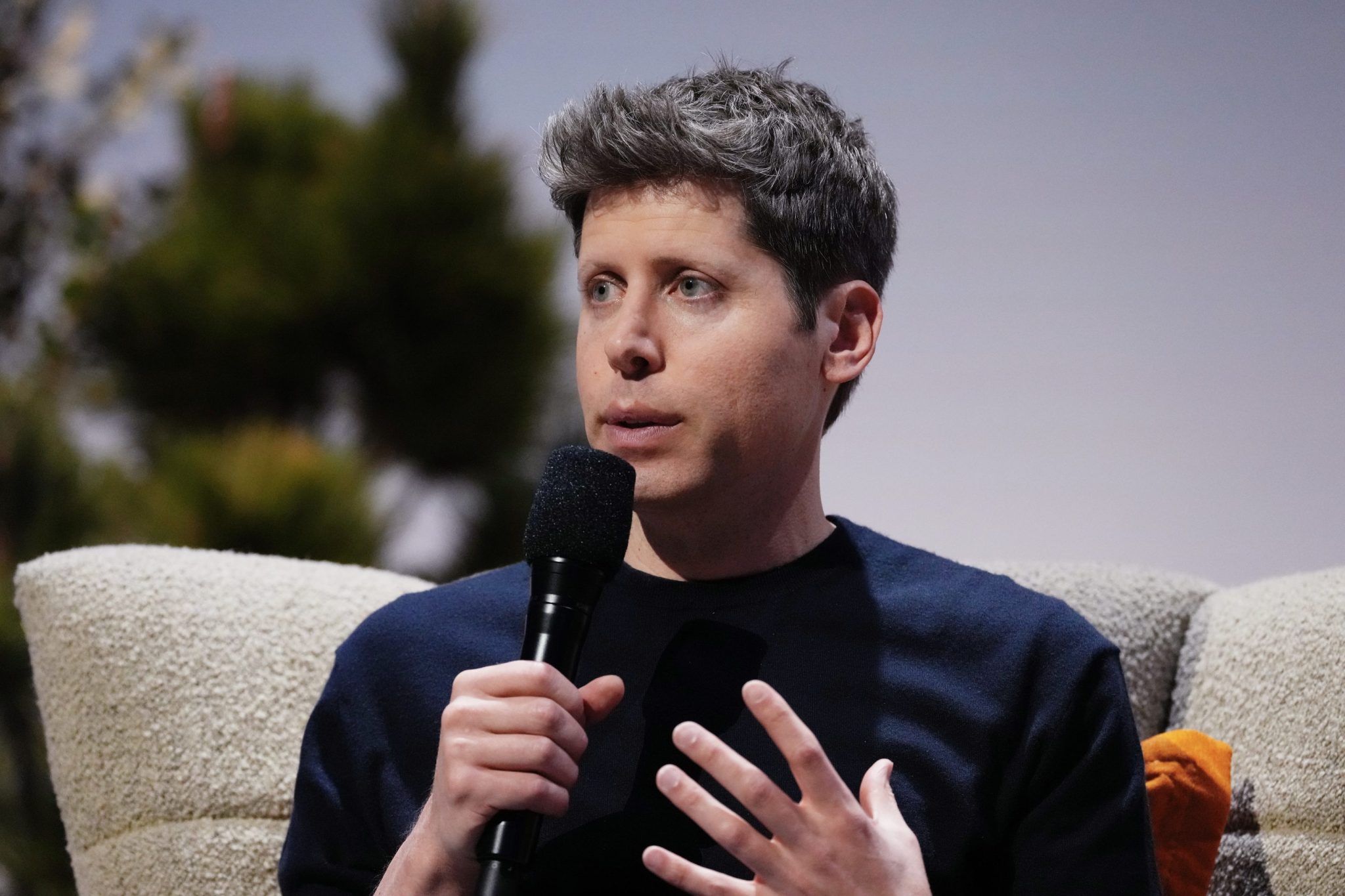
Sam Altman says he likes to relax by watching 5-10 minutes of short-form, TikTok-style videos—but admits the dopamine rush is ‘dangerous’ for kids
Sam Altman, the billionaire CEO of OpenAI, spends his days at the center of the AI revolution—but when it comes time to unwind, he’s just like millions of Americans who enjoy scrolling through TikTok before bed.
“I happen to like short-form video,” Altman said this week in conversation with Salesforce CEO Marc Benioff. “I happen to like the ability to watch 5 or 10 minutes of short-form video before I go to bed as a way to unwind and relax a little bit.”
But Altman’s relationship with TikTok-style videos hasn’t always been so measured. The 41-year-old has said that he first got into TikTok while OpenAI was developing Sora, its now-defunct video generation app, to better understand the short-form video experience. What started as a few minutes of scrolling before bed soon turned into an hour. Then, one Saturday afternoon, Altman found himself scrolling for three hours.
He eventually decided he had to temporarily step away from the app.
“I deleted TikTok because it was just too powerful,” Altman said during an episode of the Relentless podcast released in July. “I think the iPhone is amazing and yet I did not feel like I had enough self-control to keep that app.”
Altman wouldn’t let his kids near TikTok: ‘I do think it’s dangerous’
It may come as no surprise that Altman, who served as president of startup incubator Y Combinator between 2014 and 2019, would be curious about one of the tech industry’s most popular new formats. But his own experience with TikTok has given him a more cautious view of just how powerful short-form video can be.
As a father of a young son, Altman said he doesn’t believe the technology is appropriate for everyone—particularly Gen Alpha.
“I wouldn’t let my kids near that stuff, and I don’t think it’s reasonable to expect kids to be able to resist that dopamine thing or know that they even should,” Altman said. “I don’t think short form video is inherently evil, but I do think it’s dangerous.”
His concerns are reflected in some of the experiences teenagers report having on TikTok. In a survey released this year of TikTok users ages 13 to 17, 28% said they spend too much time on the app, while 37% said it has negatively affected their sleep and 29% said it has hurt their productivity, according to Pew Research Center.
After becoming a parent via surrogacy early last year, Altman has also said it changed the way he thinks about the broader stakes of the technology he is helping build. Fatherhood has made him think more deeply about the importance of getting AI right for humanity.
Like Altman, some CEOs are tuning into TikTok to understand Gen Z—and decompress
Altman isn’t the only business leader thinking about how to use social media both personally and professionally.
Feng Ren, co-CEO and head of drug research and development at Insilico Medicine, an AI drug discovery startup, recently said that one of his recommendations for protecting health and well-being is to deliberately set aside time during the day to step away from the chaos.
“The first thing I will do is sit on a sofa and relax,” Ren said at Fortune’s Leaders Forum in Macau earlier this month. For him, that often means reading WeChat messages and the news for 15 to 30 minutes—but he added that he’s in favor of scrolling on social media in moderation.
“I recommend people do it more,” Ren even said.
Other executives, like Virgin Group CEO Josh Bayliss, have said they scroll on apps like TikTok not just for entertainment, but to understand the younger consumers their businesses are trying to reach.
“The zeitgeist is not people in their 50s like me,” Bayliss previously told Fortune. “The zeitgeist is 20-something year olds who are shaping the culture that we have an obligation to serve.”
“You’ve got to have the volume turned up 24/7, honestly,” Bayliss added.
For Altman, though, when all else fails, he often returns to a more analog hobby: reading books.
“I love reading,” Altman told Fortune last week on the Titans and Disruptors of Industry podcast. “One of my hobbies is to read first-party contemporaneous accounts of previous technological revolutions.”
This story was originally featured on Fortune.com
The App That Turns Finding a Bin Into a Game
1. What is your company in 2–5 words?
Gamified bin-mapping for travellers.
2. Why is now the time for your company to exist?
Sustainability has never been more front-of-mind for young travellers — but most "green" tech is preachy and dull, so it doesn't actually change behaviour. Meanwhile, gamification and community apps have proven they can drive real-world action at scale. KrapMaps sits right at that intersection: it takes a moment where caring about the planet is culturally urgent and makes doing the right thing genuinely fun. The tools (smartphones, maps, AI verification) and the audience (a generation that wants to travel and do good) have both finally caught up.
3. What do you love about your team, and why are you the ones to solve this problem?
We're small, scrappy, and we've actually lived the problem. I built KrapMaps after ten months backpacking Southeast Asia — this isn't a boardroom idea, it came from standing on a beautiful beach with rubbish in my hand and nowhere to put it. My co-founder runs our content and community. We don't have big-company resources, but we've got the two things that matter: we genuinely care, and we move fast. Best of all, we're building something we'd use ourselves.
4. If you weren’t building your startup, what would you be doing?
Honestly, probably still travelling — and getting annoyed that an app like KrapMaps didn't exist. I've always been a builder; if it wasn't this, it'd be another product fixing something that bugged me. But I can't really picture not building. This is the thing I want to give everything to.
5. At the moment, how do you measure success? What are your metrics?
Real-world impact over vanity numbers. Day-to-day: bins mapped by the community (800+ across 29 countries), how many get verified, and how active our mappers are week to week. We also watch partnership momentum — hostels onboarded, ambassadors signed — because that's what drives growth. Long-term, the test is simple: are there more bins on the map, is there less litter around them, and is the community growing? Revenue follows engagement, so engagement is what we obsess over.
6. In a few sentences, what do you offer to whom?
For travellers: a free, fun app to find a public bin wherever you are, plus a community mission to be part of — map bins, earn rewards, help hit shared goals. For partners: hostels get a feel-good guest activity and a genuine sustainability story; brands get to sponsor real environmental action in front of an engaged travel audience; and councils and tourism boards get on-the-ground bin-infrastructure data they can't easily source elsewhere.
7. What’s most exciting about your traction to date?
The partnerships. We went from an idea to live across all 24 Mad Monkey Hostels properties in Southeast Asia — the biggest hostel brand in the region — as their launch partner. That one relationship has opened doors to more: press features, inbound interest, and proof that a bin-mapping app can genuinely earn a place in the travel world. The most exciting part isn't a number — it's that people who don't have to care about us keep saying yes.
8. Where do you think your growth will be next year?
Two directions. Geographically — beyond Southeast Asia into Europe and globally, through hostel chains and country ambassadors (the Mad Monkey model, repeated). And in engagement — leaning into big real-world moments like World Cleanup Day to rally the community. A year from now, I want KrapMaps to be the app a backpacker instinctively opens in a new city, with a genuinely active global community behind the map.
9. Tell us about your first paying customer and revenue expectations over the next year.
Here's the honest bit: our "customers" aren't our users — the app is free and always will be. Our first revenue comes through partnerships: a signed travel-insurance affiliate (Genki), plus eSIM and booking affiliates our travellers already use. Over the next year we expect revenue from three places — brands sponsoring our community sustainability goals, those travel affiliates scaling with our user base, and early data-licensing pilots with councils and tourism boards. We're deliberately not building the business on charging people to do good; we monetise the value around them.
10. What’s your biggest threat?
Two, honestly. The obvious one: a giant like Google Maps could add bin data someday — but our defence is the thing they'll never build: the community, the game, the culture. Google will never make mapping bins fun, and an empty map is useless, so the data and community we've already built are the real moat. The quieter threat is the classic early-stage one — focus and runway. As a small team there are a hundred things we could do; the discipline to do only the few that matter, and to fund them, is the real fight.
This startup founder interview template is based on HackerNoon Founder & CEO David Smooke’s ten questions for startup founders.
Would you like to take a stab at answering some of these questions? The link for the template is HERE.
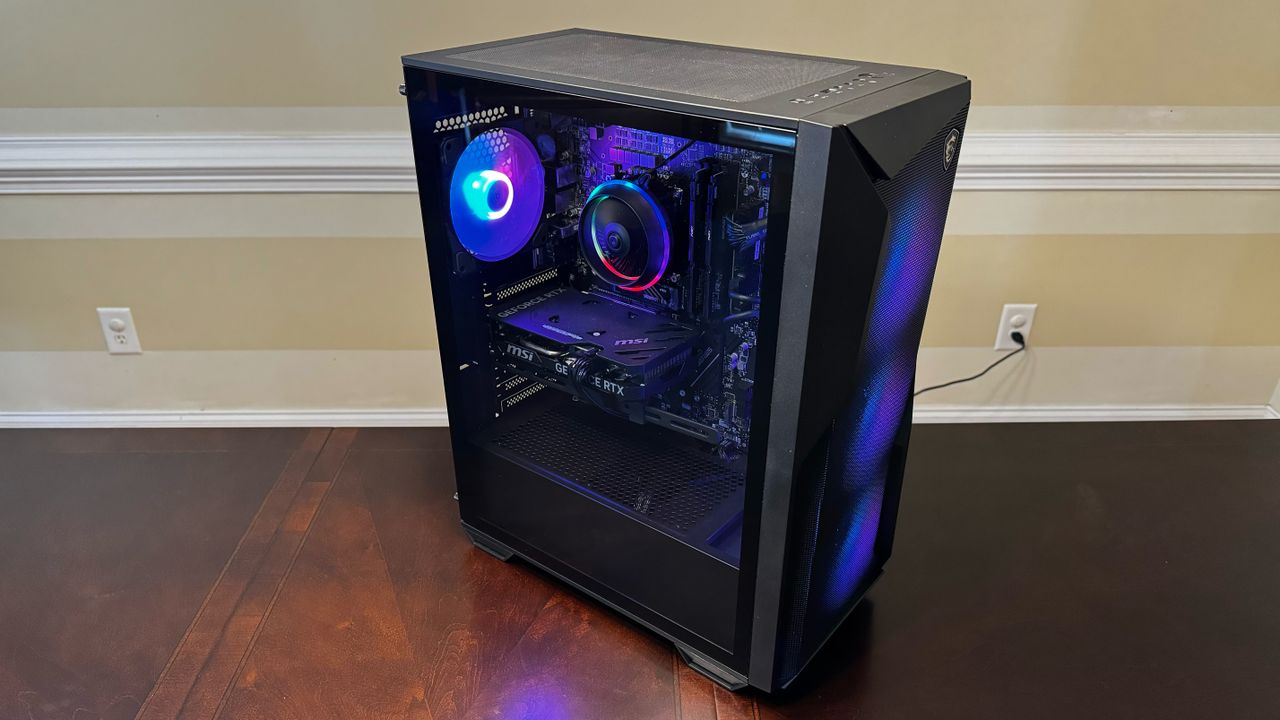
Save $270 on this solid 1080p gaming PC with an RTX 5060 from MSI, now under $1,430 — Codex R2 rig packs 32GB DDR5 RAM, a 2TB SSD, and a 10-core Intel CPU

The Pokémon TCG 30th Celebration expansion has launched: Where to buy, best deals, and market price
TL;DR: The Pokémon TCG 30th Celebration expansion has finally launched. A lot of product is already available to buy on Amazon and other top retailers, including the under-market-price deal for the Elite Trainer Box — still sold on Amazon for $83.44 per invite request.
The Pokémon 30th Celebration collection is causing a stir in the trading card game market. We've all been waiting impatiently for this one, and there's now more to buy compared to when Pitch Black and Chaos Rising launched. That's great news for collectors.
This expansion is incredibly special, with not only historic reprints (like the classic Charizard), but also special SIRs, and a rare Pikachu card in every booster pack. It's worth noting that only some products in the range are available to buy right away. Others are being made available later this year.
With that, we've tracked down every available box, pack, blister, and collection you can immediately buy from the Pokémon TCG 30th Celebration. Plus, we've listed what you can already preorder for later in 2026.
Best Pokémon TCG 30th Celebration deal

Why we like it
The 30th Celebration Elite Trainer Box officially launched on Sept. 16, but Amazon's $83.44 invite-only offer is still the price to beat. It takes $6.55 off the retailer's $89.99 price, provided Amazon approves your request to buy.
Oddly, this is the only product from the 30th Celebration range to be added to Amazon’s high-demand, invite-only system. That may be because the U.S. retailer is testing the waters to gauge the impression it leaves with American customers. This system has been widely used on Amazon UK for the Pokémon TCG for some time.
Amazon’s deal makes this the best place to buy readily available 30th Celebration Elite Trainer Boxes. TCGplayer's lowest current ETB listing is $150 plus $2.25 shipping, while Walmart has the box at $159.95.
Inside are nine 30th Celebration booster packs, a full-art foil Nidorina promo, 16 foil Basic Energy cards, 65 card sleeves, a player's guide, six damage-counter dice, a competition-legal coin-flip die, a plastic coin, a collector's box with dividers, and a Pokémon TCG Live code card.
Pokémon TCG 30th Celebration products you can buy right now
The ETB isn't the only product launching on Sept. 16. Amazon has several other main collections available, while TCGplayer currently offers several products that aren't as easy to find elsewhere. Prices below are as of Sept. 16:
Pokémon TCG 30th Celebration Poké

Owala’s exclusive Pokémon just dropped at Target: Shop Pikachu, Eevee, Charizard, and Gengar designs


The Swan: Behind The Mirror trailer: The controversial reality TV show is ripe for its reckoning
Reality TV in the 2000s got truly wild, and by that I mean repellent.
Remember the Fox show The Swan, wherein average women were challenged to go to radical extremes to change their appearances, and presumably by extension their lives? Well, Hulu's The Swan: Behind The Mirror not only will dig out these dusty memories of trash TV past, but also reveal what it was like for the so-called "ugly ducklings" who survived it.
From Erin Lee Carr, the documentarian behind Mommy Dead & Dearest, Fanatical: The Catfishing of Tegan and Sara, and Britney vs. Spears, comes a documentary that is sure to get the internet buzzing. Carr is known for intimate interviews with controversial figures, including the "cannibal cop" Gilberto Valle, Gypsy Rose Blanchard, and convicted killer Lois Reiss. So, what secrets might she pry out of the producers of The Swan? From the trailer alone, you can see some folks don't have the sense to hide their inner ugliness. And we can't look away.
The Swan: Behind the Mirror premieres on Hulu and Hulu on Disney+ on Sept. 29.

Enterprises are sweating legacy IT assets as AI investment grows
The Best Movies to Stream This Month (September 2026)

字节跳动上半年营收1200亿美元直追Meta,但受AI投入拖累,利润降至200亿

FRC holds public panel on artificial intelligence - The Plumas Sun
How WebRTC Scales: Signaling, NAT Traversal, and the Mesh/SFU/MCU Tradeoff
Web Real-Time Communication (or WebRTC) is the open standard browsers use to send audio, video, and data straight to each other. There's no plugin or native app, nothing beyond an API that every browser already ships.
WebRTC covers the media path: once two peers have found each other, everything from codec negotiation to encoding to transport is handled. What it never covers is the finding part.
This article discusses the three APIs that make up the spec, why signaling and NAT traversal live outside it, an implementation of a signaling server at scale, and the mesh/SFU/MCU tradeoff that decides how the media itself scales.
Table of Contents
The Building Blocks: Three APIs, One Gap
WebRTC exposes three JavaScript APIs to do this:
RTCPeerConnectionnegotiates codecs between the two peers and handles encoding, decoding, and transmitting the media stream once a connection exists.MediaStreamgets it something to send, wrapping access to a webcam or microphone.RTCDataChannelruns alongside the media connection for anything that isn't audio or video, chat messages, file chunks, game state, or any application data that doesn't need a codec.
None of them know how to find a remote peer on their own. That's the part WebRTC leaves out entirely.
Signaling and the Offer/Answer Exchange
Before two peers can exchange media, they have to exchange a description of what they're capable of: codecs, network info, media types, and encoded as SDP (Session Description Protocol).
WebRTC ships no mechanism for actually delivering that description between peers. That's signaling, and the spec deliberately leaves it up to whoever's building on top, typically over WebSockets or HTTP long polling.
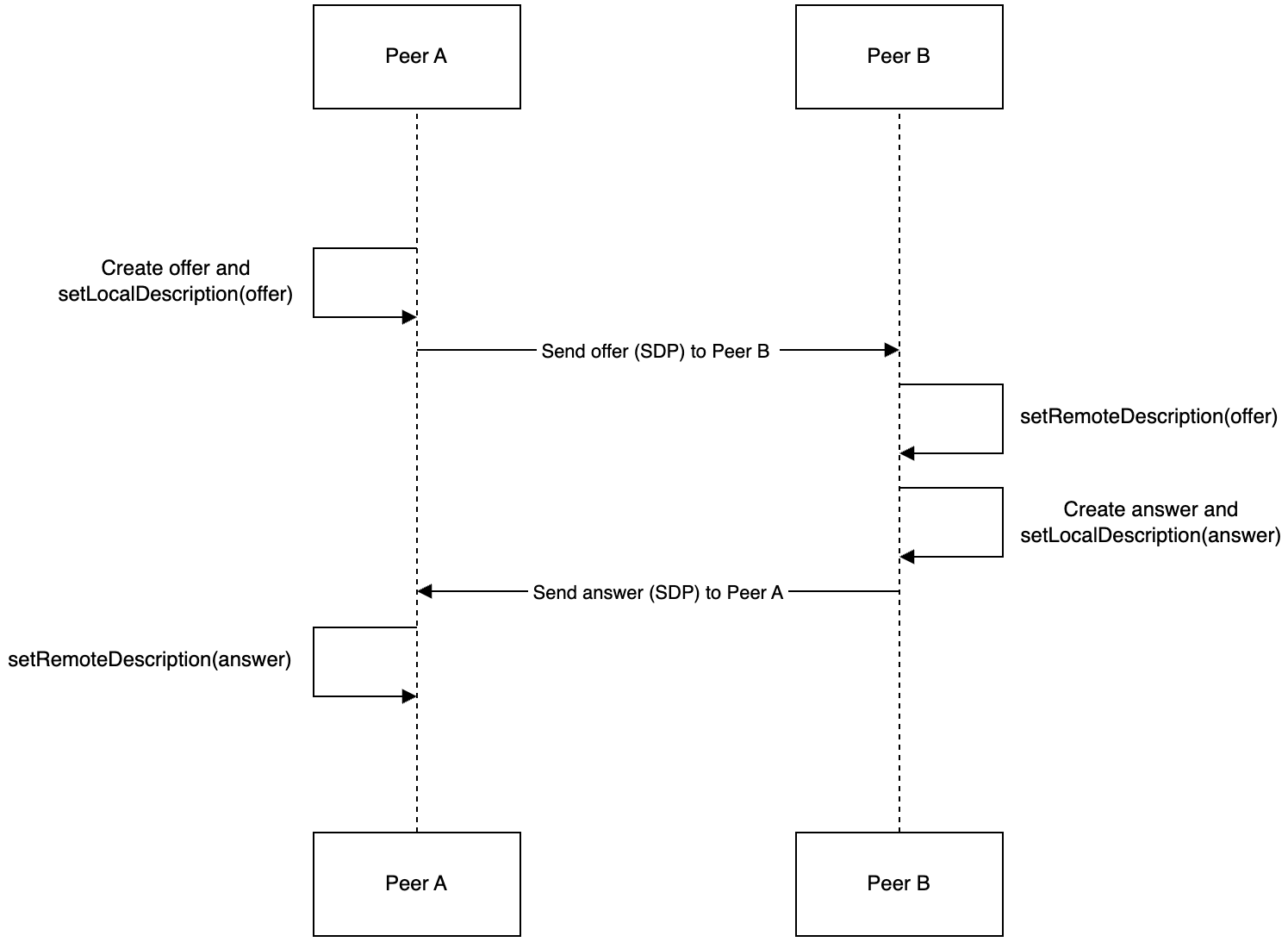
The exchange itself follows a fixed shape, an offer from the peer initiating the call and an answer from the peer receiving it:
// Peer A: create and send the offer
const pc = new RTCPeerConnection({ iceServers });
const offer = await pc.createOffer();
await pc.setLocalDescription(offer);
signalingChannel.send({ type: 'offer', sdp: pc.localDescription });

// Peer B: accept the offer, respond with an answer
await pc.setRemoteDescription(offerFromA);
const answer = await pc.createAnswer();
await pc.setLocalDescription(answer);
signalingChannel.send({ type: 'answer', sdp: pc.localDescription });

// Peer A: complete the handshake
await pc.setRemoteDescription(answerFromB);
setLocalDescription and setRemoteDescription are the only two calls doing any real work here. Everything else is just getting the SDP blob from one peer's signaling connection to the other's.
NAT Traversal: ICE, STUN, and TURN
An SDP exchange tells each peer what the other supports. It doesn't tell them how to reach each other, since most devices sit behind NAT or a firewall with no directly routable address.
ICE (Interactive Connectivity Establishment) is the piece that solves that, gathering every address a peer might be reachable at and testing them until one works. Those addresses, called candidates, come from two kinds of servers: STUN (Session Traversal Utilities for NAT) and TURN (Traversal Using Relays around NAT).
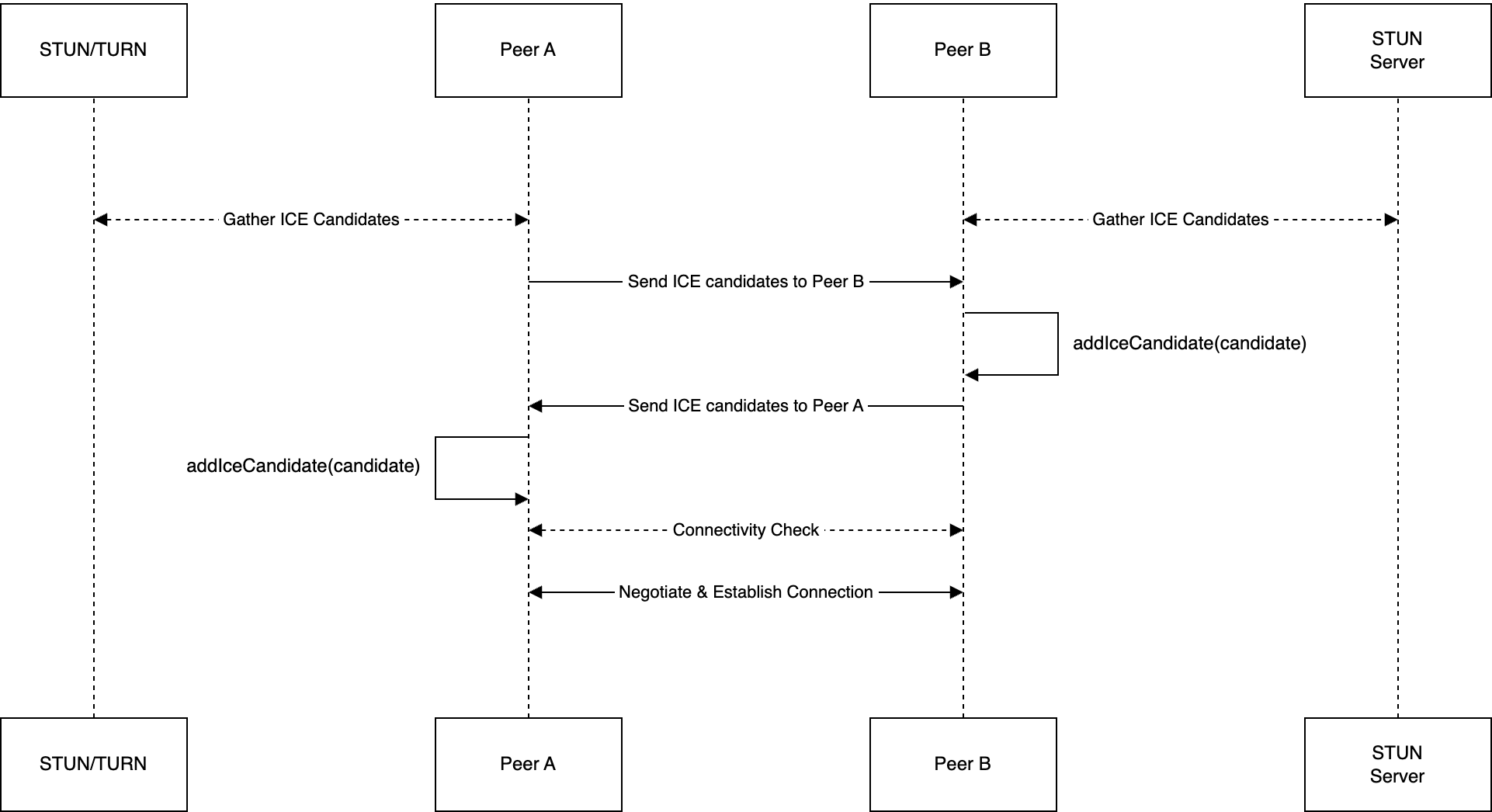
The diagram shows a single peer gathering three candidate types in parallel: a host candidate from its own network interface, a server-reflexive candidate returned by a STUN server (the public IP and port its NAT mapped it to), and a relay candidate allocated on a TURN server. All three are sent to the remote peer as ICE candidates, and whichever pairing connects successfully is the one used for the call.
STUN handles the common case: a peer asks a STUN server what public IP and port the NAT mapped it to, and uses that as a candidate address.
TURN is the fallback for when STUN isn't enough. Symmetric NAT and some firewall configurations block direct connectivity outright, so a TURN server relays traffic between the two peers instead. It works in every network configuration STUN can't, at the cost of routing every packet through a third server instead of directly between peers, adding latency and consuming server bandwidth for the duration of the call.
Candidates can be exchanged two ways. First, regular ICE can wait until every candidate is gathered before sending any of them. This is simple but adds latency up front: the connection can't start negotiating until the slowest candidate finishes gathering.
Second, trickling ICE sends each candidate the moment it's found, so negotiation starts on whichever candidate arrives first instead of waiting on all of them. But this comes at the cost of needing both peers' signaling and ICE implementations to handle candidates arriving incrementally rather than all at once.
For time-sensitive applications, trickling is worth the added implementation complexity. Most modern WebRTC stacks support it by default.
// Sending side: forward each candidate the moment ICE finds it
pc.onicecandidate = (event) => {
  if (event.candidate) {
    signalingChannel.send({ type: 'ice-candidate', candidate: event.candidate });
  }
};

// Receiving side: add each candidate as it arrives, don't wait for the rest
signalingChannel.on('ice-candidate', ({ candidate }) => {
  pc.addIceCandidate(candidate);
});
An Example Implementation
To see where these pieces actually cost something at scale, I built a signaling server MVP:
Node.js for the server, since its single-threaded event loop handles many concurrent WebSocket connections without the overhead of a thread per connection, and
Express for routing and Socket.IO
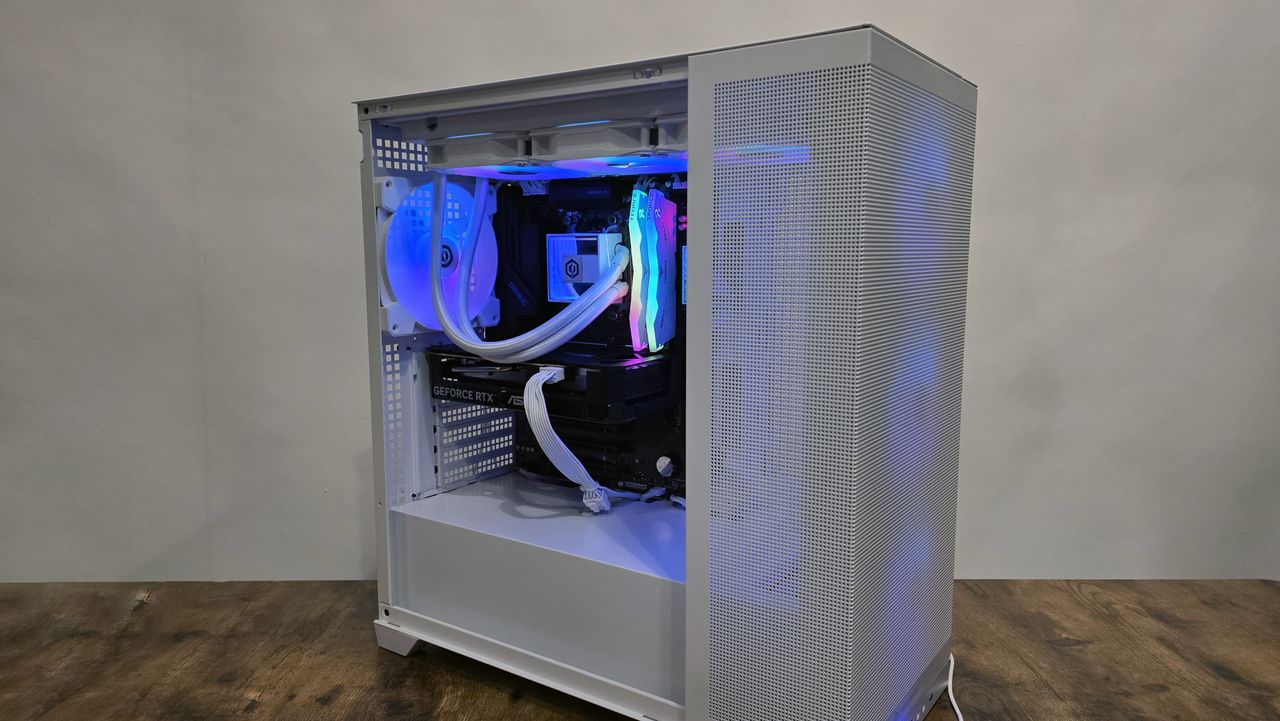
Grab a $560 saving on this 1440p-ready gaming PC with a 9800X3D and RTX 5060 Ti 16GB, now $1,859 — all-white CyberPowerPC desktop ships with one of AMD's best X3D chips, along with 32GB DDR5 and a 2TB SSD
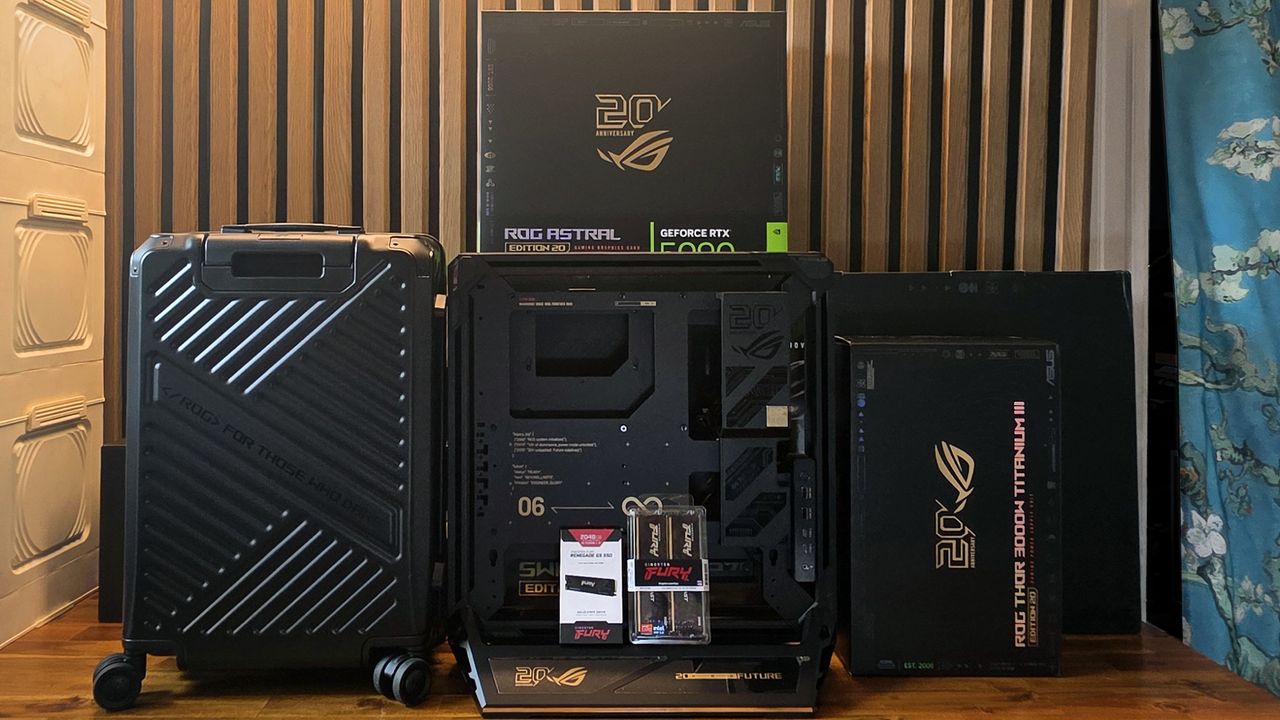
Asus' ludicrous $10,850 20th-anniversary bundle is now the cheapest way to buy an RTX 5090 — Nvidia's flagship GPU stock is so limited that this bundle with a 3000W PSU, X870E board, and open-frame case is actually cheaper than some scalper listings
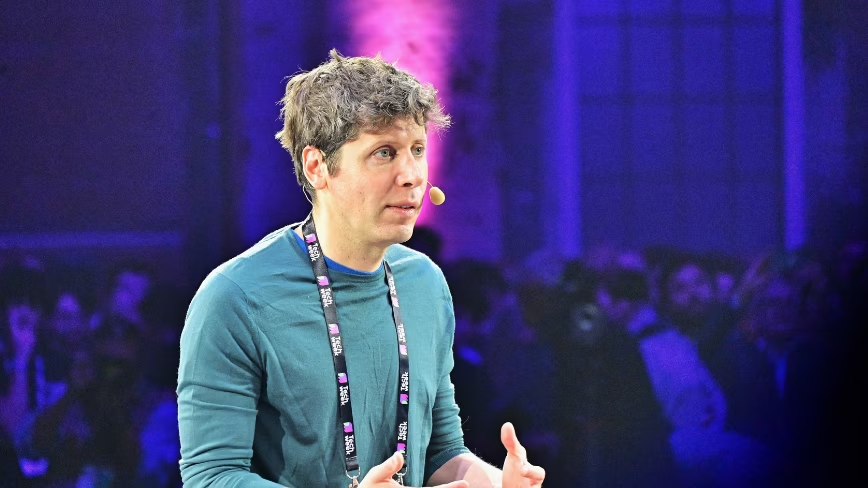
“The world is right to be afraid”: Sam Altman on AI power at Dreamforce
OpenAI chief executive Sam Altman said the public is right to fear that a few AI companies could gain too much power. He spoke on Tuesday at Salesforce’s Dreamforce conference in San Francisco. Salesforce has published the conversation, led by its chief executive Marc Benioff, on YouTube. Altman described a real fear that some AI […]
This story continues at The Next Web
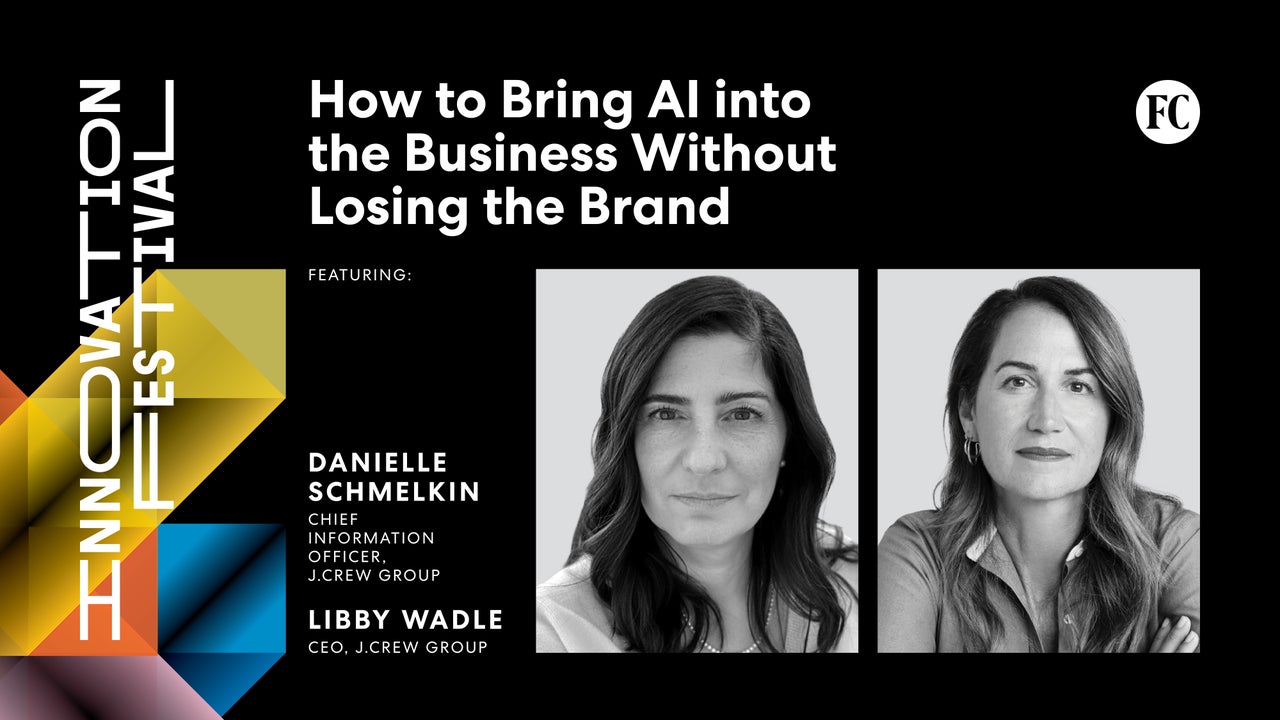
How to Bring AI into the Business Without Losing the Brand
Featuring Danielle Schmelkin, Chief Information Officer, J.Crew Group and Libby Wadle, CEO, J.Crew Group
Moderated by Elizabeth Segran, Senior Writer, Fast Company.
AI adoption isn’t just a technology challenge—it’s a culture challenge. For creative, customer-focused companies, the question isn’t simply where AI can make the business faster or more efficient, but how to put it to work without flattening the judgment, taste, and human connection that make a brand matter. J.Crew Group CEO Libby Wadle and chief information officer Danielle Schmelkin are tackling that question from both sides of the C-suite, building AI fluency across the organization while helping teams identify practical, secure, and scalable ways to use the technology. In this conversation, they’ll share what it takes to move AI from scattered experimentation to meaningful adoption, how CEOs and CIOs can work together to drive change, and why the companies that get AI right may be the ones that use it to amplify—not automate away—their most human advantages.

The rare Pokémon TCG 30th Celebration Mewtwo card is available for free — how to get yours
TL;DR: Score the 30th Anniversary Mewtwo promo card for free by spending $15+ on Pokémon TCG products at select retailers. This special offer starts from Oct. 2.
If you're a Pokémon card collector, you know the absolute nightmare that is fighting off secondary-market scalpers the second a limited-edition card drops.
There is another way.
To celebrate three decades of pocket monsters, The Pokémon Company is dropping a limited-edition Mewtwo promo card starting Oct. 2. Instead of forcing you to drop $100+ on a massive Elite Trainer Box, you only need to spend $15 or more on any Pokémon TCG products to trigger the gift-with-purchase.
The card features an exclusive "Pokémon 30" foil stamping that won't appear in standard booster packs. Plus, every promo card comes with a secondary QR code card that links directly to the Pokémon Night Out event experience. It's valid both online and in-store, but given how quickly anniversary merch disappears, you'll want to lock in your order without delay.
The participating retailers are as follows:
Barnes & Noble
Best Buy
BoxLunch
Five Below
GameStop
Hot Topic
Macy’s
If you're trying to figure out what to buy to hit that $15 spend limit, the actual 30th Celebration expansion lands worldwide on Sept. 16.
The set is a massive trip down memory lane, featuring remastered artwork, classic card reprints, and an unprecedented gimmick: every single booster pack contains a guaranteed rare Pikachu card out of a set of 30 unique designs. Grab a four-pack of individual booster sleeves or a single Booster Bundle at checkout, and you'll hit that $15 threshold for the Mewtwo card. It's that easy.