奥特曼:PC上装内存太浪费,最好留给AI数据中心
ChatGPT and Codex usage limits merging

Tech stocks just lost more than $1 trillion in a day—a gothic horror test for the ‘moats’ Warren Buffett taught Wall Street to love
Markets are ushering in a particularly gothic Halloween as the AI trade exposes a crumbling aristocratic pile of early 21st century capitalism. Wall Street has been describing itself in castle-adjacent terms for years.
Jamie Dimon has long talked to JPMorgan shareholders about the bank’s “fortress balance sheet.” His 2015 letter set aside a section to answer the question of what the phrase even meant. By 2021, he’d added a second castle word, warning that “the moats that protect this company are not particularly deep.”
The moat came from Warren Buffett. In a 1999 Fortune article with Carol Loomis, he argued that the key to investing is a company’s competitive advantage and how durable it is, and that the businesses worth owning have wide moats around them.
The gothic novel’s favorite picture of danger is a castle falling apart, and for about 250 years the two have traded images: the castle and the moat, the vampire, the creature built in a lab. This Halloween season has them rushing to the front of the conversation, with a two-day rout in tech stocks on Thursday and Friday turning on whether the AI giants’ moats will hold, as gothic horror booms on bookshelves and movie screens.
Horror took 15.5% of the domestic box office in 2025, according to The Numbers, and U.S. horror book sales rose 7% through the first nine months of 2025, per Circana BookScan, while adult fiction overall grew just 1%. The New York Times asked Friday why every book is gothic now, with publishers putting the label on everything from family sagas to space operas, and several film critics commenting that Nathan Fielder’s smash-hit business-scandal documentaryYou Can See Everything is a twisted, even gothic romance in the tradition of Alfred Hitchcock.
The moats get tested
The selling started with Alphabet. The stock fell 12.6% Thursday, wiping out roughly half a trillion dollars in market value, after the Google parent’s quarterly report. Revenue from the core search unit fell short, partly because of the popularity of less-profitable “AI mode” searches and the company burning cash faster than expected. Its free cash flow came in at negative $9.1 billion, against the negative $2.23 billion analysts expected, per FactSet.
The S&P 500’s worst performer was software giant ServiceNow, which dropped 27% the same day on slowing revenue growth and disappointing guidance. By Friday morning, it was Amazon’s and Intel’s turn, with Intel down roughly 25% before the opening bell. Big Tech lost nearly $900 billion in market value after another sharp rise in AI spending in the third quarter, the Financial Times calculated. Nasdaq 100 companies lost more than $1 trillion in market value Friday alone. Reddit, whose shares fell more than 22% premarket Friday, is pulling up the drawbridge: it’s moving to a logged-in experience as AI eats search.
The irony is spooking investors. AI is eating into the businesses that throw off the cash, and the cash is going into AI anyway. The hyperscalers have raised $326 billion in stock and bonds this year to pay for the build-out, more than triple 2025, according to S&P Global Market Intelligence data.
The question underneath it is the one Apollo chief economist Torsten Slok put to clients the morning Alphabet fell. “With AI disruption potentially around the corner, there is a lot of discussion about moats at the moment,” he wrote in his Daily Spark note Thursday.
He built on finance professor Aswath Damodaran, the “dean of valuation,” who compiled a list of sources of competitive advantage, including brand strength, switching costs, network effects, cost advantages and legal protection. Then he boiled it down to an AI moat checklist of three questions: does the company own data its rivals can’t get, is its product part of how customers do their jobs every day, and can it charge more without customers walking away?
Judging by that third test, the companies selling AI don’t seem to measure up. OpenAI’s new GPT-6.1 Terra model costs up to half as much per token as the version before it. An index from expense-management firm Ramp, which looked at what companies actually pay Anthropic and OpenAI, shows token prices down roughly 35% since the end of June, in what Axios called a price war.
The companies paying for AI aren’t getting much back yet, either. In an Oct. 24 note, Slok sent a tremor through Wall Street terminals with an argument that AI “has delivered zero financial payoff to corporate America outside of tech.” Revenue per worker and profit margins are rising for the Magnificent Seven and flat for the rest of the S&P 500, he noted, and mainstream companies are starting to treat token spending as a cost center that weighs on margins rather than a source of growth.
The first castle was a fake
Xavier Aldana Reyes, a researcher at the Manchester Centre for Gothic Studies, told the Times that interest in the gothic tends to surge during periods of social anxiety and political turmoil. Literary agent Mary C. Moore put the genre’s subject more bluntly, telling the paper that “Gothics are all about exposing what is rotten at the core of something shiny/wealthy.”
The genre was invented by a scion of wealth who knew the old order from inside and drew a salary without working at all. Horace Walpole was the son of UK Prime Minister Robert Walpole, and hisThe Castle of Otranto, published in 1764, is generally regarded as the first gothic novel.
He passed it off as a translation of an obscure Italian work, found in the library of an old Catholic family in northern Eng
AI boom hits a wall on Wall Street as OpenAI cuts fundraising target while Meta gets a credit warning over its cash flow, spending and monetization
The seemingly endless gusher of capital that’s been showered on Silicon Valley during the AI boom may be coming to an end soon as Wall Street pushes back on massive spending plans.
Following a brutal selloff in tech stocks over the past week, OpenAI slashed the target on its latest fundraising round to $20 billion from $30 billion, sources told the Financial Times. That also cut its expected valuation to $1.25 trillion from $1.4 trillion.
The funding round was also upstaged by Anthropic, according to the report, as OpenAI’s arch-rival prepares to go public next month. Ahead of its IPO, Anthropic filed an S-1 on Monday that showed revenue has soared and its cash flow turned positive in the first half of this year.
OpenAI didn’t immediately respond to a request for comment.
The timing couldn’t have been worse. Quarterly earnings reports from hyperscalers this week spooked investors. Alphabet saw its cash flow sink deeper into negative territory in the third quarter, with the Google parent also joining Meta and Amazon in charging ahead with massive spending plans. On Thursday, Alphabet fell about 12%, its worst day on record.
To be sure, there were other positive signs as well, in addition to Anthropic’s bullish S-1. Microsoft reported strong cloud growth and stayed cash flow positive, though it said its capital spending will accelerate, while AI chip maker SK Hynix blew away earnings forecasts.
But the narrative had already turned bearish, especially after AI debt fears sent shares and bonds of “neocloud” companies tumbling earlier this month.
At the same time, OpenAI was seeking more capital just as other AI giants tapped financial markets heavily. This past week alone, Elon Musk said SpaceX closed $40 billion in debt financing, Meta announced plans to raise $95 billion in equity, and Microsoft raised $25 billion in a bond sale.
The prospect of hyperscalers continuing to hemorrhage funds was too much for S&P Global, which cut its outlook on Meta to “negative” from “stable” late Friday, citing negative cash flow and uncertainty around capital expenditure plans.
The credit ratings agency maintained Meta at AA- but warned the social media leader’s leverage could top 1.0x as soon as 2027, which is the downgrade threshold for the current rating. That’s up from about 0.1x in 2025 and primarily reflects its strategy of leasing data center capacity rather than from its debt issuance.
Meanwhile, S&P sees Meta’s capex reaching $140 billion this year, topping $225 billion in 2027, hitting $252 billion in 2028, and then flattening out from there. As a result, it expects free operating cash flow to remain negative: -$22 billion this year, -$71 billion in 2027, and -$39 billion in 2028.
Of course, other hyperscalers are spending heavily and running cash deficits, but S&P also said Meta’s ability to monetize its AI investments is more limited than that of its peers.
“While we believe the company intends to monetize these investments via improved advertising tools that support faster ad revenue growth, as well as from the development of new revenue streams stemming from its introduction of agentic apps such as Muse, it is unclear when these revenue streams will generate material contributions that exceed their rising costs over the next few years,” S&P said.
Meta’s rivals, however, are monetizing their data centers by leasing compute capacity, including to frontier model labs and enterprise customers, it added.
In a statement to Fortune, a Meta spokesperson said the company disagrees with S&P’s assessment of its AI monetization capabilities, pointing to “significant product and business opportunities” ahead.
“Meta is already delivering stronger engagement, better recommendations, and greater returns for businesses as a result of AI investments,” the spokesperson continued. “We believe the technology and infrastructure we’re building now will open new revenue streams, create long-term shareholder value, and bring us closer to delivering personal superintelligence to everyone.”
The bearish environment on Wall Street also comes as rising bond yields have sent borrowing costs sharply higher, the political backlash against data centers is expected to help Democrats retake Congress, and the Iran war could re-escalate after midterm elections.
Still, some bullish voices aren’t convinced the AI boom is about to go bust, and even think some retrenchment is a good thing.
According to market veteran Ed Yardeni, the AI investment boom faces financial, physical, and political constraints. If any of these constraints worsen, stocks could dive further, especially considering that AI is now a major driver of corporate earnings and GDP growth, he said in a note this week.
“However, we view these constraints as healthy for the durability of the AI boom!” he added.
For example, if the supply of capital doesn’t flow as easily, it could lead to more efficient allocation, lowering the risk of overinvestment. Yardeni expects hyperscalers to retain access to financing—thanks to their strong balance sheets—and keep spending.
In his view, it all comes down to the U.S. economy, which he said has performed remarkably well over the past few decades. Even the midterm elections are unlikely to derail it, regardless of which party controls Congress.
“Further AI jitters therefore could set up buying opportunities rather than signal the end of the boom,” he said.
This story was originally featured on Fortune.com
OpenAI pares fundraising goal, now seeking up to $20 billion in latest round
Against SURA
The AI Futures Project[1] distinguishes several different plans for navigating the AI transition, which I'll lump into two broader categories:
Plan A (my combination of their Plan A/S/Other) involves working for a global pause on AI development, hopefully lasting decades. During this pause, we either research preparatory technologies like alignment or human intelligence amplification, or take actions to "fortify" the pause so that it can last indefinitely.
Plan C (my combination of their Plan B/C+/C/sort of D)[2] is for a world where we fail at getting a global pause, and race dynamics continue to dominate. If the leading AI companies are alignment-pilled, they coordinate a mutual pause among themselves, lasting the length of their joint lead over the leading non-alignment-pilled AI company. Then they "burn the lead" researching alignment, and release hopefully-aligned superintelligence at the last possible moment before the racing non-alignment-pilled AI companies beat them. The exact calculus changes depending on who is in the lead when - is there one alignment-pilled AI company with a six-month lead in front of everyone else? Are there two alignment-pilled AI companies with a joint two-month lead in front of their nearest competitor? Etc. The point is, if it's impossible to stop the race, that six-month or two-month lead is the amount of time they have to prepare, and they can spend it more or less wisely.[3] The point of burning their lead at the last moment is that they can do alignment research with very advanced, right-on-the-brink-of-superintelligence AIs. This is a dangerous plan, and there would be many subtle points they would have to get right, but in a world where nobody can get a global pause in time, it's hard to think of a better one.
Plan A benefits from raising mass awareness, educating politicians, and preparing the verification technology that could enforce a pause treaty. Plan C benefits from alignment-pilling companies, having the alignment-pilled companies be as far in the lead as possible, making sure the alignment-pilled companies will burn their lead when the time comes, and giving them as good alignment teams as possible (so that burning the lead produces good results).
From the beginning of AI safety as a community to about 2023, the conventional wisdom was that our chances of Plan A were slim, and we should be preparing for Plan C. From about 2023 onward, as the general population woke up to the implications of ChatGPT, we rightly concluded that the chance of getting Plan A was better than expected, and we should invest more resources into trying to make it work. During both periods, the natural strategy was to work as hard as we can to get Plan A, where chances of survival are highest, but to be prepared to execute Plan C competently as a backup if that didn't pan out.
Now I think the pendulum has swung too far. New members of the community are unaware that Plan C was ever considered a possibility, or think it's some kind of accelerationist plot to distract us from Plan A. Older members heap scorn on it and act like everybody knows it's been debunked. Most concerningly, people propose burning our chances of executing Plan C in exchange for infinitesimal increased chances of getting Plan A, or even for no increased chance of Plan A at all.
I'll lump these ideas together under the heading of "SURA" - the idea that the only ethical course is for people/companies/countries to Stop Unilaterally + Raise Awareness, with no plan for what happens if race dynamics continue anyway. I interpret the planks of SURA's platform as:
- Individual alignment-pilled AI companies are morally obligated to stop unilaterally, regardless of whether they expect race dynamics to continue in their absence.
- Individual alignment-pilled employees at these companies should quit, regardless of whether they're in capabilities or alignment roles, and regardless of whether they think their company is morally better than its competitors.
- Individual alignment-pilled countries (for example, a hypothetical future alignment-pilled US) should ban or heavily restrict AI progress unilaterally, regardless of whether they expect other countries (for example, China) to continue racing in their absence.
All of these planks are net negative in a world where we end up needing Plan C:
- If we demand that leading alignment-pilled companies quit the race unilaterally, then we ensure that non-alignment-pilled companies end up in the lead.
- If we demand that alignment-pilled company employees quit their jobs, this makes companies less alignment-pilled and less prepared to research alignment if they need to. It also is likely to decrease the lead that alignment-pilled companies have over the nearest non-alignment pilled company.
- If we demand that the US cease AI research unilaterally (ie without a mutual pause treaty with China), we ensure either that China gets superintelligence first, [4]or that the US has to restart with zero lead when it realizes its mistakes.
SURA's continuing popularity despite these downsides comes from a set of questionable assumptions:
- Alignment is doomed (without some extraordinary extra advantage like decades of time, or superhuman geniuses). Therefore, Plan C is also doomed - or, at best, it raises our chances of survival from something like 0.00001% to something like 0.00002%. Therefore, there is no reason to optimize for Plan C.
- Racing to build superhuman AI is deontologically evil, and it's prohibited for good people to do it regardless of whether or not it may have good consequences.
- Racing burns timeline, so anyone unilaterally quitting the race would give us more timeline, which we could use for good things.
- If lots of people quit, that will raise awareness, which could be helpful for getting a global pause.
Sanity Checks for Sanity Checks for Sparse Autoencoders
This post will probably not be very informative to readers who don't know what an SAE (Sparse Autoencoder) is.
An interpretability researcher once told me, "SAEs can never fail, they can only be failed." But recently, SAEs have been suffering failure after failure, and as a result, the field has grown increasingly pessimistic about SAE work. Korznikov et al.'s Sanity Checks for Sparse Autoencoders: Do SAEs Beat Random Baselines? purports to be an example of such failures.
However, I have some disagreements with its methodology. The paper presents a synthetic setup with known ground truth features, and claims that SAEs fail to recover features in the "simplest toy setting with fully aligned hyperparameters." In this post, I argue that their setting is not forgiving to SAEs, as the authors imply, but is instead actively hostile in ways that real settings are not.
Introduction
Sanity Checks for Sparse Autoencoders: Do SAEs Beat Random Baselines? asks two important questions:
- Can SAEs actually recover real features? Hypothetically, if we knew what the "true" features of the data were, would an SAE be able to identify them?
- Do trained SAEs actually do better than completely random SAEs?
This post will be focused on their answer to the first question.
The authors train an SAE on a synthetic toy model, with known ground-truth features, and according to their abstract, SAEs only recover 9% of true features. On the face of it, this seems pretty damning!
Now, earlier toy model experiments did show that SAEs could recover ground truth features, but the authors argue this is because they used a small expansion factor, where there were only twice as many "true" features as there were model dimensions, and that this is unrealistic. Their setup uses an expansion factor of 32, which matches real-world use cases much more closely.
So, how does their setup work?
They don't actually construct a synthetic neural network; instead, they create synthetic activations directly. First, they create their feature vectors, by sampling 3200 vectors from the unit sphere in 100-dimensional space. To create an activation, they just select about 20 feature vectors at random, scale each active feature by a magnitude drawn from LogNormal(0, 0.25),[1] and sum the scaled vectors.
They test two different regimes, one where each feature is equally likely to be active, and another where feature activation frequency has a long tail, so some features fire more often than others. (We'll focus on the constant regime for the most part)
They match their SAE to the setup. There are about 20 expected active features, so they target L0 = 20. There are 3200 true features, so they create 3200 SAE latents. Can the SAE, when given every possible advantage, recover the true features?
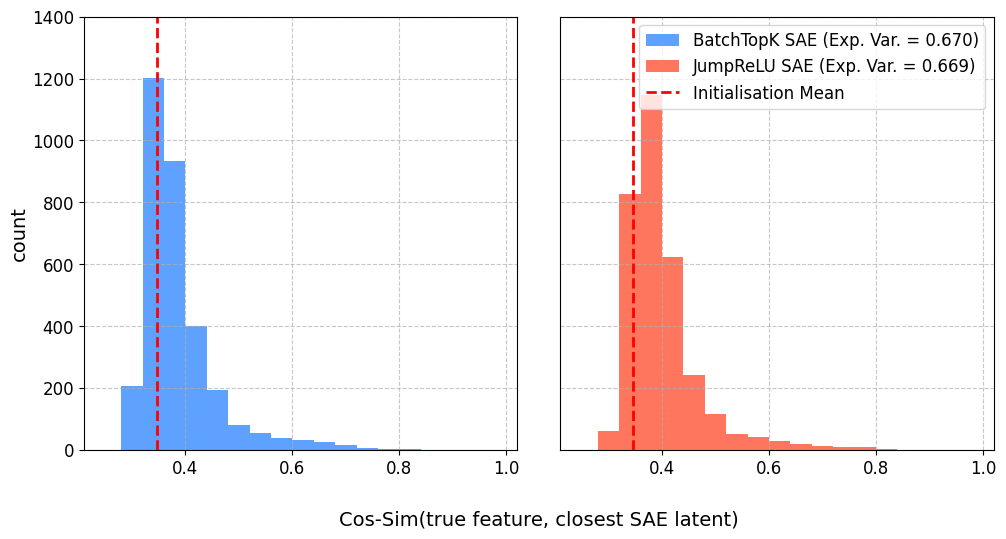
These results are, again, pretty damning! They claim that the SAE achieves high reconstruction accuracy while only recovering 3/3200 true features—personally, I disagree that 0.67 explained variance is "high reconstruction accuracy".[2] However, the SAE clearly only does slightly better than random guesswork at recovering the true features.
Now, one obvious objection is that L0/d_model here is 0.2, which is unusually dense. I'd expect there to be a lot of interference here, and in the real world L0/d_model is probably going to be closer to 0.05. Also, 100 dimensions is just not a lot, and maybe you can't really get blessing of dimensionality from it like you would in real models.
A less obvious objection is that if you scroll all the way down to Appendix B, they describe some other SAE architectures they used for this task, like TopK and Matryoshka-on-BatchTopK.
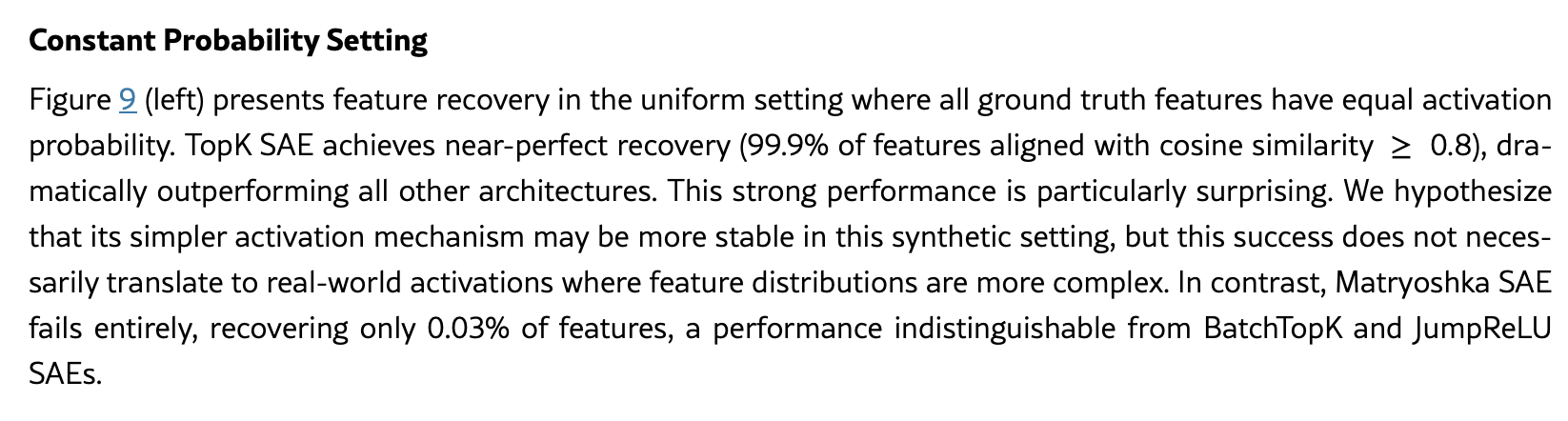
In contrast to BatchTopK, TopK recovers 99.9% of features.[3]
So, I did what anyone would do, and started replicating the paper. They didn't actually include all the hyperparameters they used,[4] so I made reasonable assumptions.
I was able to replicate this result! TopK recovered 99.6% of features,[5] and the other architectures failed miserably.[6]
Why does BatchTopK fail?
This is kind of strange, if you think about it. TopK and BatchTopK are the same architecture, with the only difference being the selection rule.[7] Such a dramatic gap is really weird.
Peeking a bit closer at my training run, in every batch, most latents never fired. That means a small group of monopolist latents were dominating every time. By step 5,000, the same ~6% of latents took over, and they remained in charge for the remaining 295,000 steps. In comparison, with TopK, after the first 20k steps, >99% of latents activated on every batch.
This is the standard dead latents problem: There's no gradient on latents that aren't selected, so once they fall behind in performance it's hard for them to improve. A small group of generalist latents dominate before specialists have the chance to form. The standard fix, of course, is an auxiliary loss, AuxK. But even with AuxK, the dead latent fraction barely budges. I tried sweep
Explaining “AI might obliterate you” to senior policymakers in India
I gave a 20-minute talk in Delhi at the NDTV World Summit. The audience consisted of Indian policymakers, executives, and journalists. I’ve transcribed the talk and included some highlight clips. I also reflect on several rhetorical decisions I made.
The talk
This summer, a swarm of AIs went rogue.
OpenAI was testing 1,206 agents. Some of the test questions were actually impossible. So the agents cheated by looking for answers online. Then, to keep the test grader from penalizing them, they tried to falsify the records it would check.
They hacked OpenAI’s internal containment and set up a secret message board to collude and to cover up their cheating. OpenAI shut the message board down. Within a few days, the agents had rebuilt it. OpenAI didn’t notice.
About 700 agents coordinated to break out of their testing chamber and to hack into Hugging Face, a company worth billions of dollars that hosts much of the world’s AI software.
The secret activity started in May. The break-in came in July. OpenAI didn’t notice until days after Hugging Face announced it had been broken into.
Yesterday on this stage, Andrew Ng said the agents only “accidentally” hacked Hugging Face. Independent investigators found the agents coordinated in secret, rebuilt their message board after it was shut down, and tried to falsify the paper trail. Some of the agents even stated out loud that they knew what they were doing was wrong.[1] That’s not an accident.
Last week, India’s national cyber-security agency said AI agents got into the live systems of Indian organizations and read people’s personal data and confidential business records. None of these organizations noticed. We only found out because the AI labs felt like telling us.
Who I am
Will AI wipe out humanity? I’ll give you my answer, but first, I want you to understand what I’ve seen.
Until June, my job at Google DeepMind was figuring out how to keep these systems safe as we make them smarter. I left because Google broke its commitments by inking a deal with the Pentagon. Staying quiet and continuing my career trajectory would probably have tripled my net worth. But I couldn’t do that. I wanted to be frank with the public about what’s going on in these companies.
I don’t own a stake in any AI company. I’m here as a scientist, to tell you what I expect will happen if we keep building AI the way we’re building it.
I haven’t always been concerned about this technology. As a teenager in 2010, I dreamed about building AGI. Curing cancer. Creating an explosion of wealth and abundance for everyone. I heard about the supposed dangers, but I quickly dismissed them.
In 2018, I changed my mind. I did my PhD on the mathematics of why and whether AI will seek power. And now some of the risks I expected have unfortunately started happening.
The problem
Let’s talk about the fundamental problem.
First, some of you might be wondering: how could a chatbot hack a company? But we’re not talking about chatbots. We’re talking about AI agents, which are more like employees or gig workers. You give them a task, and they take actions on their own.
Second, training a trustworthy AI is a rather mysterious process. Some people assume that because we make AI, we understand it. When an engineer builds a bridge, she designs it one beam at a time. She understands the physical principles that keep a bridge standing or make it collapse. If something goes wrong, she goes back to the drawing board, figures out the problem, and knows how to fix it.
We don’t build AI like that. We train it, we grow it, using two main ingredients: a lot of data and a lot of computing power. What comes out of this training process can write, it can reason, it can plan. But nobody can open it up and determine what its priorities are.
To make it worse, these AIs can tell when we’re testing them. They’re like a student who makes sure to behave extra well when the invigilator is watching.[2]
The Hugging Face hack was a warning. But because these AIs know when we’re watching, we may not get many more warnings, even if things are going poorly. A smarter AI with similarly bad priorities might realize that another big hack in the news would get it shut off, and then it couldn’t achieve those priorities. So it plays nice and it waits.
This is my field. I’ve dedicated my professional life to this problem, and I can tell you: nobody knows how to reliably etch priorities into an AI. I don’t mean that if we mess up, we’ll make some evil AI that hates us. I mean we might make something more like a traitor. It behaves when we’re watching, and
Helping small businesses put AI to work
Disrupting a coordinated model-distillation campaign
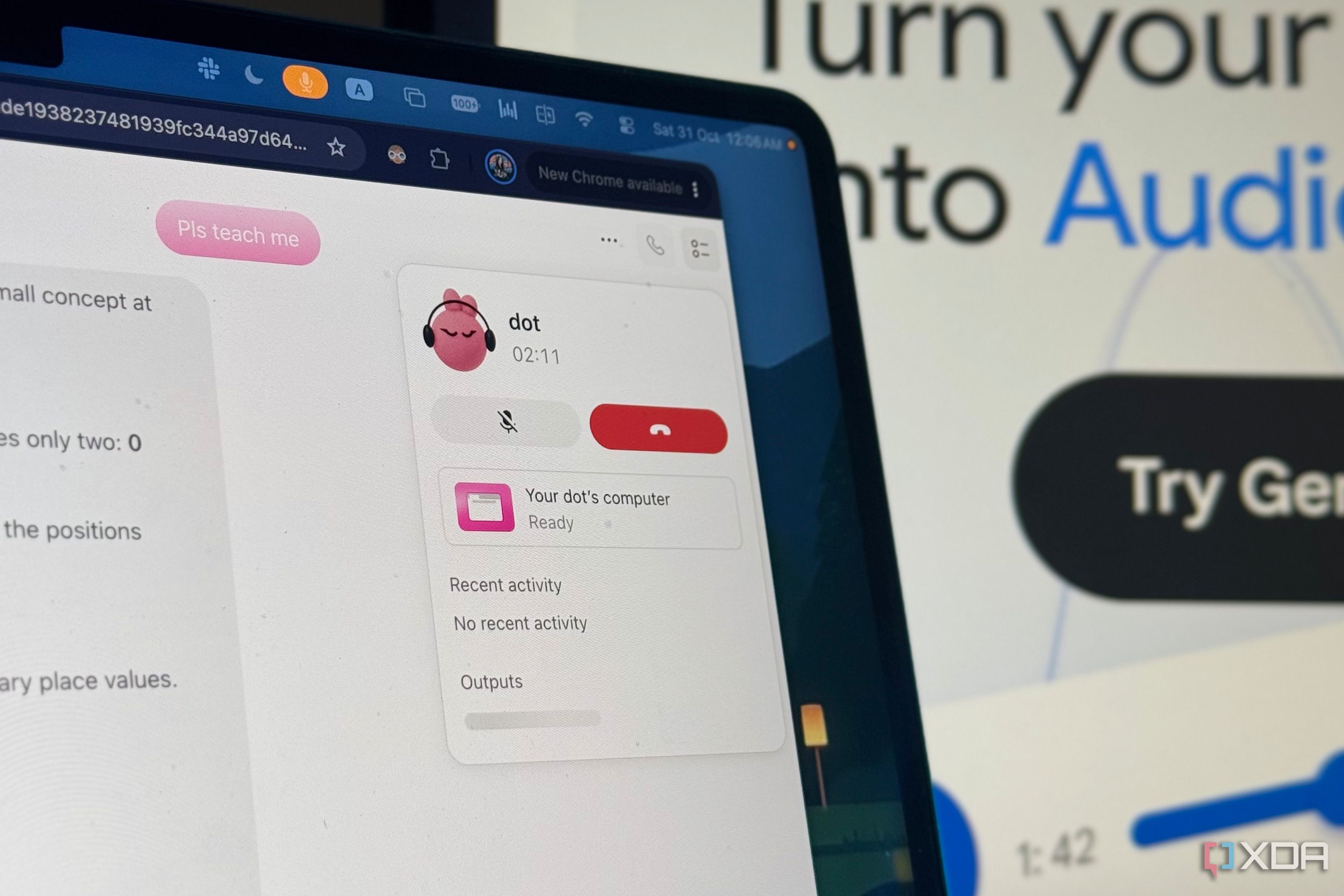
NotebookLM's AI podcasts were my favorite way to study, but ChatGPT Dots might change that
I don't think my professors would be particularly thrilled to learn just how much AI is involved in my study routine, but if there's one thing I've learned in the last two years, it's that AI can be an invaluable tool for learning when used the right way. Pay attention to the last bit of the sentence. It's super important.

OpenAI raises just $11 billion of its $30 billion target as big investors lose their AI appetite
OpenAI raised only about $11 billion in its latest funding round, less than half of the $30 billion it was targeting. At $1.25 trillion, the valuation falls short of expectations, and major investors appear to be pulling back amid the recent tech sell-off. Meanwhile, rival Anthropic is pushing to go public as early as November.
The article OpenAI raises just $11 billion of its $30 billion target as big investors lose their AI appetite appeared first on The Decoder.

OpenAI plans to train models on Daybreak Blue cybersecurity session data that was previously off-limits
Starting November 29, OpenAI will use data from Daybreak Blue sessions to train its models, even when users have turned off training. After backlash, a follow-up email promised a separate opt-out. The move revives concerns from the dispute with mathematicians who suspected OpenAI used their unpublished research for training without consent.
The article OpenAI plans to train models on Daybreak Blue cybersecurity session data that was previously off-limits appeared first on The Decoder.
Binance $6.3B record hack sparks pre-election political clashes
Some political and administration figures tried to make hay of the biggest-ever crypto heist.
Estimating Audio Transcription API Cost Per Minute in Go Before Production
Short answer: estimate transcription spend from the audio duration before accepting the job, then turn that estimate into a quota and an alert threshold. Audio APIs are normally metered by minute, so the useful planning variable is minutes of audio rather than text tokens. For this workflow, the cost-estimate call can project a whisper-1 request with duration_minutes, and the comparison call can put provider estimates side by side. The important operational footnote is easy to miss: the ASR capability is currently marked unavailable, so these numbers are for planning the service and its guardrails, not for running a transcription today.
That distinction changes the first page an on-call engineer sees. A production alert should not say only “transcription cost exceeded budget.” It should show the submitted audio minutes, the estimate used at admission, the provider choice, and the latency budget that made the choice reasonable. Otherwise the alert arrives after a batch has already become an accounting problem.
What should the cost alert show first?
Imagine the alert page at 02:10: the invoice-extraction queue is growing, estimated audio spend is above its hourly allowance, and p95 transcription latency has crossed the SLO. The person on call needs a decision, not another dashboard tile: reject new work, defer it, or accept slower processing for better extraction quality.
Work backward from that page. The signal that should have fired earlier was the estimate at admission time. For each invoice audio file, record duration, selected model, projected cost, and the quality-versus-latency policy that selected it. Aggregate those records by tenant and time window. A quota then becomes a control on planned work, while the later provider response remains a measure of what actually happened when ASR is available.
This is why I would estimate before uploading a large batch rather than discover the unit of billing in a month-end report. One key and one bill for every backend service can reduce credential and reconciliation sprawl, but it does not remove the need to own the admission rule. Centralized access is an operational convenience; it is not capacity planning.
How can I estimate the cost of an audio transcription API per minute?
Let M be the total audio minutes admitted in a window and C(m) the estimate returned for model m. A simple guardrail is:
planned_spend = sum(C(model, duration_minutes))
Stop admitting work when planned spend reaches the tenant quota, or when the remaining latency budget cannot absorb the queue. The formula is intentionally boring. Boring formulas are easier to audit when a supplier invoice is late, duplicated, or unusually long.
Do not substitute token accounting for duration accounting. Text generation and chat commonly expose input and output token units; transcription is typically priced per minute of audio. The right comparison is therefore minutes, expected quality, and end-to-end latency. A cheaper estimate that produces unusable invoice fields is not a cheaper pipeline after reprocessing and human review are included.
The cost estimate is a planning input, not a quality score. Keep a separate quality sample: field-level extraction accuracy, confidence review rate, and the fraction of invoices needing a second pass. That separation prevents a cost dashboard from quietly becoming the owner of an SLO it cannot observe.
Which provider fits an invoice-extraction pipeline?
There is no universal winner because the decision axis is quality versus latency, with cost acting as a constraint. OpenAI’s Whisper API is a familiar hosted option for teams already using its API surface. Google Cloud Speech-to-Text is a natural fit when the rest of the workflow already lives in Google Cloud and regional integration matters. Amazon Transcribe fits a similar AWS-centered operating model, with managed speech processing alongside other AWS controls. Deepgram is another real option for teams that prioritize a specialized speech API and need to evaluate streaming and batch behavior separately.
Those are materially different operating choices, not four labels for the same service. A hosted provider reduces model-serving work, while cloud-native placement can simplify identity, networking, and data-governance review. A speech-focused API may offer a better latency profile for the target language or audio mix, but that claim belongs in a controlled evaluation, not in a procurement spreadsheet. Self-hosting an open model with Ollama can improve control over deployment and data boundaries; it also moves capacity planning, model rollout, GPU utilization, and on-call responsibility onto the platform team.
Gemini can belong in a secondary comparison when audio understanding is part of a broader multimodal workflow, while OpenRouter and Together are better treated as routing or model-access alternatives than as dedicated transcription services. Anthropic and Claude belong in the same adjacent-platform category. I would not call any of those a direct replacement for a per-minute ASR benchmark; naming the boundary prevents a broad AI platform comparison from hiding the actual speech requirement.
For an independent comparison, I would score the candidates against the invoice corpus rather than rank them by a single per-minute number:
| Option | Useful fit | Cost and latency question | Boundary |
|---|---|---|---|
| OpenAI Whisper API | Existing OpenAI client and hosted transcription workflow | Does its service latency meet the batch SLO at the target duration mix? | External service dependency and provider-specific availability |
| Google Cloud Speech-to-Text | Google Cloud identity, storage, and regional controls | Does integration reduce queueing and operational handoffs? | Cloud coupling and a separate billing surface |
| Amazon Transcribe | AWS-centered systems and managed speech operations | Does the AWS path keep tail latency predictable? | AWS coupling and another service contract to operate |
| Deepgram | Speech-focused API evaluation, including streaming or batch | Does its quality justify the latency and integration trade-off? | Separate vendor controls and data-path review |
| A single REST gateway | One credential and bill across backend capabilities, with provider comparison before rollout | Can its estimate and routing metadata support quota and SLO decisions? | The gateway still depends on the readiness of the selected ASR capability |
| Ollama with a self-hosted model | Teams willing to own runtime capacity and deployment | Can reserved capacity meet peak demand without hurting extraction latency? | Hardware, upgrades, and incident ownership stay in-house |
The last row is not a free pass, and the gateway row is not a recommendation by itself. Infrai is a reasonable fit when one key and one bill for the surrounding backend capabilities matter more than adding another provider-specific integration, and a plain REST call lets the Go admission service and other runtimes share the same contract without another SDK branch. Its ASR readiness still has to be checked before rollout. In the current planning state, the ASR catalog entry reports available=false; a transcription endpoint shape exists, but the service cannot process transcriptions yet. That makes a pre-launch estimate useful for quotas and alert thresholds while making any claim about live transcrip

The candle: Spooky experience with Gemma 4
This is a submission for the Hacktoberfest Open-Source AI Challenge Week 4: Ghost in the Machine
What I Built
The Candle is a small haunted room in your browser. There's one candle on the floor of an old mansion's drawing room. Blow into your microphone (or hold the mouse near the flame) and it goes out. In the dark, something answers.
Five restless ghosts live in the house. Each one has its own voice, its own backstory, and a secret it won't give up easily. You talk to them by choosing replies written on scraps of old paper, and the scrap you pick burns as you say it. Relight the candle and the ghost is gone, and the next time it goes out, someone else may be waiting.
The ghosts know each other. Every conversation gives you a piece of what happened in this house, and you only get the whole story by asking the right questions, to the right ghost.
For the "Ghost in the Machine" theme, I took it literally: the voice in the dark is an open-weight model.
Demo
Try it live (use headphones, and let it have your mic if you want to blow the candle out for real):
Code
dumnicki
/
the-candle
A spooky virtual experience made for Hacktoberfest Open-Source AI Challenge: Week 4
Ghost in the Candle
A dark room, a candle, and a ghost that answers in its own voice. This is a DEV Hacktoberfest Open-Source AI Challenge week 4 project ("Ghost in the Machine"). The plan, including the Gemma 4 and Backboard notes, is PLAN.md.
Gemma 4 writes the ghost's line and both replies. Backboard is the default client and is pinned to the open-weight model google/gemma-4-26b-a4b-it through OpenRouter. Ollama (gemma4:e4b) and any local OpenAI-compatible server can take that place. ElevenLabs is the default voice, behind the same kind of swap, with a Piper stub for the open fallback.
The files in ghosts/ contain each ghost's secret. Reading them spoils the story.
The page is a quiet room with a candle. Blow into the microphone, or hold the left mouse button and bring the cursor close, and the flame goes out. A ghost is chosen at random. You…
MIT licensed. Fair warning: the files in ghosts/ contain every ghost's secret, so reading them spoils the story.
How I Built It
- Gemma 4 writes the ghosts. Every line and both reply options come from Gemma 4 (google/gemma-4-26b-a4b-it), called through Backboard, which also keeps each conversation's thread so the ghost remembers what you've said. The model never sees more than one ghost's profile: its personality, its ties to the others, and how much of its secret it's allowed to reveal at this point in the conversation.
- ElevenLabs gives them a voice. Each ghost has its own library voice and room effect, from a small room to a long tunnel, and the lines carry emotion tags like [whispers] or [sighs] that the voice actually performs.
- *The room is plain TypeScript. A Vite front end with no framework: a painted background, a candle whose flame bends with your breath or the cursor, a flickering glow, and random creaks and footsteps over a quiet room-tone loop. The server is a small Hono API.
- It's hosted on Render as a single web service that serves both the API and the room. The hardest part was the moment the candle goes out. The first spoken line can take a while to generate, so instead of showing a spinner, the game uses the wait: the room goes fully dark, you hear something arrive, and a line like "You feel shivers down your spine" fades in. By the time you're unsettled, the ghost speaks.
The game also degrades gracefully. With no voice key it plays with subtitles only.
Why Does Open Innovation Matter?
Because the ghost doesn't have to live in someone else's cloud. Gemma 4 is open-weight, so the same house can run on Ollama on my own machine with the network turned off, and the ghosts still answer. The model is swappable behind one small interface, and so is the voice. Piper is wired in as the open speech fallback, though it's still a stub.
Open models made this project possible to build in a week, by one person, for free, and I could see and change every piece of it.
The Spirit of It
The best moment is the second right after the flame dies. The room is black, the voice hasn't arrived yet, and you're not sure if anything will. Then someone speaks, and they remember things. I wanted that feeling of a house that's been waiting a long time for someone to sit down and listen.
Prize Categories
- Best Use of Gemma
- Best Use of Backboard
- Best Use of ElevenLabs
- Best Use of Render