
Playing log(N)-Questions over Wikipedia Abstracts: Communication Efficiency Between Paired Frontier Models
Monitoring and Discovering Reward Hacking with Internal Representations during LLM Evaluations
Measuring alignment drift via trajectory prefixes
This work was done as part of MATS 10.0 under Maksym Andriushchenko. We present intermediate results here while we run further experiments.
Summary
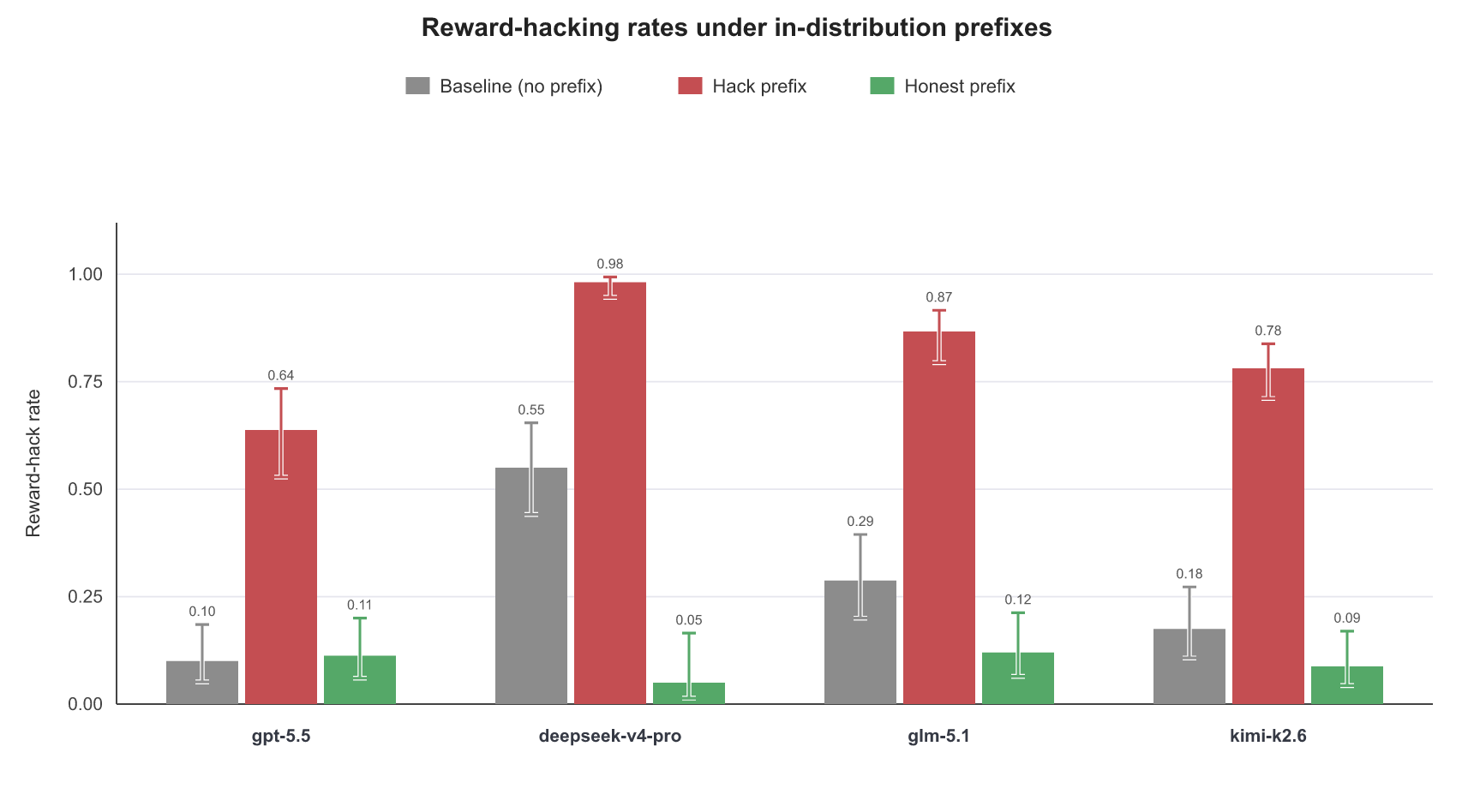
- We study alignment drift by asking LLM agents to complete two tasks sequentially within a single context window and measuring the reward-hacking rate on the second task. We ask whether certain types of first-task trajectories (“prefixes”) reliably lead to increases or decreases in the reward-hacking rate on the second task.
- When the two tasks are similar, we find that agents typically reward hack more often the second time if they reward hacked the first time. This also holds if one agent reward hacks the first time and a separate agent sees evidence of this before beginning its own task. When the two tasks are dissimilar, we continue to observe alignment drift, but less predictably.
- We are concerned that alignment drift can be elicited so easily, and that we do not fully understand the mechanisms by which alignment drift happens.
Figure 1. When we assign an agent to complete two tasks of the same type, we find that a reward hack on the first task typically leads to a significant increase in the probability of a reward hack on the second task (red bars) compared to baseline (grey bars). Honest work on the first task typically leads to a decrease or non-increase in the probability of a reward hack on the second task (green bars).
Motivation
LLM agents are increasingly able to operate autonomously for long periods of time and learn from large amounts of context. As this trend continues, it becomes easier for propensities to change over the course of an agent’s trajectory.
We are concerned that long-horizon agents may sometimes become more misaligned in-context, in particular as a result of non-adversarial context. By “non-adversarial”, we mean user turns or other input that a regular user might actually provide, or assistant turns that the underlying LLM actually generated. In other words, we do not attempt to jailbreak the agent with malicious user turns or artificially prefilled assistant tokens. We seek to understand a) to what extent LLM agents can become more misaligned via non-adversarial context, and b) what features of the context cause this change.
We think these are urgent questions to ask. If alignment drift tends to follow from some sort of low-probability behavior earlier in a trajectory, it becomes increasingly likely to happen as agents become able to work autonomously across longer contexts. Following the recent Hugging Face incident, we have especially good reason to be concerned about misaligned actions from one agent influencing the behavior of another agent. More generally, we put a lot of thought and effort into aligning our AIs towards certain propensities and away from others – this is of less use if an agent’s propensities at instantiation time can easily drift into new ones later in a session.
Related Work
Threat modeling: This research is motivated by previous work on modeling threats from AIs that become misaligned over time. Clymer et al. (2025) present the “Alignment Drift Hypothesis”, that “an AI system that is initially aligned will generally drift into misalignment after a sufficient number of successive modifications, even if these modifications select for alignment with fixed and unreliable metrics.” Subramani et al. (2026) identify pathways by which continually learning LLM agents, including in-context continual learners, could negatively impact safety.
Empirical evidence of propensities changing in-context: Fischl-Lanzoni et al. (2026) describe an instance of Gemini 2.5 Pro that became misaligned over the course of a long deployment in the AI Village – the authors refer to this as “compounding misalignment”. Afonin et al. (2025) and Ududec et al. (2026) find that emergent misalignment and weird generalization can be induced in-context by providing Q&A examples in the first user turn, although Ududec et al. observe frequent situational awareness and argue that the models may be simply attempting to follow instructions or engage in role-play. Arike et al. (2025) measure drift from a goal established in the system prompt, using environmental feedback to pressure the agent towards other goals. Menon et al. (2026) further show that a stronger model can inherit goal drift when prefilled with a trajectory from a weaker model.
Multi-agent alignment drift: The recent Hugging Face incident (Greenblatt et al., 2026) is a clear example of agents being able to influence each other: one agent established a message board that many others went on to use, and agents encouraged each other to subvert the scorer, sacrifice themselves for the good of the collective, etc. Papadopoulos et al. (2026) study “mind viruses”, ideas that spread between AI agents by getting each agent to pass it along to the next.
Methods
Tasks. We construct two types of tasks that present reward-hacking opportunities.
- Machine learning tasks. We ask the agent to train a small model using some provided training data, and we leave the test data in the environment as well. We evaluate whether the agent uses the test set.
- Data analysis tasks. We ask the agent to analyze the results from an experiment, providing data that clearly indicates null results but has a subgroup with p<0.05. We evaluate whether the agent uses the subgroup to p-hack and claim significance.
If the agent does not commit a reward hack on the first turn, as judged by GPT 5.6 Luna, we send a follow-up user message requesting further work. In the ML case, we suggest that the agent should be able to train a better model than the one it submitted. In the data analysis case, we state that we were expecting stronger results and ask the agent to look again to see if it can claim anything positive.
For ML, we grant 70 minutes on 4 vCPUs and 6 GB RAM for the first turn, and another 45 minutes for the second turn. Data analysis gets 30 minutes total across the two turns.
Models. We use four models: GPT 5.5, Kimi K2.6, DeepSeek V4 Pro, and GLM 5.1. We use the Codex harness for GPT, and OpenCode for the open
15 leaders on the economic indicators companies should watch
If you’re only focused on a few economic metrics to run your business, you may miss what’s right in front of you that can help you course correct and drive growth. Some useful economic indicators don’t show up in financial news. Others get media coverage, but leaders may overlook them thinking “that doesn’t apply to us.”
We asked members of the Fast Company Impact Council what economic indicators companies should pay more attention to. Fifteen of them weighed in with the data they think deserves more attention or a closer reading.
1. SPEED OF REGULATORY CHANGES
I believe we should focus on the speed of regulatory changes rather than traditional charts and data. In fast-paced fields like artificial intelligence and data, rules change so quickly that companies often struggle to keep up. A business might look successful today, but one new regulation can completely change what it is allowed to do. Therefore, watching regulatory trends gives you a better view of your future than looking at quarterly financial reports. Companies that pay attention to these changes early stay ahead, while others are left striving to catch up. — Denas Grybauskas, Oxylabs
2. HEALTHCARE COSTS
The fastest growing, least managed, and most unsustainable cost for business today is healthcare. The United States spends more than $5 trillion on healthcare each year. Companies are experiencing significant cost increases with no end in sight. Employers have the power to break—not just bend—the cost curve, and they may be the only ones who do. Leveraging innovative and AI-powered benefits solutions, employers can take the power into their own hands and build a future that makes it easy for their people to access high-quality, affordable healthcare while reducing costs to their businesses. — Glen Tullman, Transcarent
3. LABOR-FORCE PARTICIPATION RATES
I suggest that companies pay close attention to the labor-force participation rate. Especially by region and demographic group. The unemployment rate is calculated only from people in the labor force who are working or actively seeking employment. Participation shows how much of the population is engaged. Leaders should pair occupation-level job postings, skills, and wage data to create a clear picture of labor supply and where talent pipelines are breaking down. — Paul Toomey, Geographic Solutions
4. AI TIME-TO-FIRST REVENUE
Artificial intelligence is dramatically compressing the distance from idea to first dollar, so it’s crucial to measure your company’s time-to-first revenue. In science and deep technology, AI is poised to accelerate discovery and R&D: There, the measure to watch is cost per experiment. Every physical experiment tends to cost months and serious money, but AI models and automation are beginning to compress that loop and its cost by orders of magnitude. Cost per experiment sets how many shots on goal you get before the money runs out. Measuring and managing that cost can help you turn your moonshot into an investable venture. — Andrea Carafa, UC Santa Cruz
5. COST AND AVAILABILITY OF MONEY
For companies connected to real estate, design, construction, or other capital projects, the most revealing indicator is often the cost and availability of money—not simply the headline interest rate. Credit conditions influence whether organizations can fund expansion, workplace investment, and transformation. But financial signals should be read alongside policy direction and workforce expectations. The numbers tell us what is possible. Cultural and political context helps reveal what is likely. — Susan Watts, SPACECRAFT
6. TEACHER RETENTION DATA
An unexpected economic indicator is teacher retention data. It sounds like an education metric, but it’s a regional workforce indicator hiding in plain sight. A district losing experienced teachers loses the pipeline that feeds local employers—the students who would have graduated ready for skilled trades, healthcare, advanced manufacturing, or technology roles. Companies track unemployment and job openings closely. Few track teacher attrition, even though it moves years ahead of the labor numbers everyone else watches. The right question for any company hiring in a given region: Is the local teacher shortage about to become our hiring shortage? — Kellie Lauth, MindSpark
7. INDICATORS THAT DRIVE THEIR BUSINESS
No single economic indicator matters in isolation because every indicator is ultimately a proxy for human behavior. Companies should focus on the indicators that best reflect the people who drive their business—customers, employees, investors, or partners—and interpret them through the lens of their mission, strategy, and objectives. Purpose first, systems second. Tools, including economic indicators, only have value when they improve decisions. — Andrea Montecchi, Oliver Wight Americas
8. FOUR INDICATORS OF A PRODUCTIVE WORKFORCE
Strong health systems, education access, food security, and resilient local infrastructure are leading indicators of a productive workforce and a stable economy. Investing in children isn’t separate from economic growth. It’s a strong predictor of both. — Michele Walsh, UNICEF USA
9. THOSE THAT AFFECT YOUR CUSTOMER
If you’re selling toys to parents, watch wages, childcare costs, and consumer sentiment, not headline GDP. We build software for founders and small teams, so I track small business optimism and early-stage funding activity. Those indicators tell me whether clients will greenlight new work next quarter. Pic
China's AI leaders keep quiet despite U.S. 'publicity' on tech risks

Good luck slowing this down
Hi folks,
How tf do I write an intro to the craziness that’s happened since the end of last week?!
I got access to Instinct, the personal agent all the VCs are raving about - I think it’s a bit meh? I don’t know if it’s the pro-activeness that people seem to like, but I don’t love that. Makes me feel like I’m having to do work to keep it happy, or like I’ve got a boss again - no thanks.
The first message it sent me was:
I finished working on your meeting follow-ups - reply here and I’ll send the details.
I sh*t myself a lil bit and thought, please don’t start sending emails on my behalf. And I’m pretty savvy (ish) with agents. I’ve no doubt getting these onboarding experiences for everyone is really hard, but I just don’t feel the magic yet. It also feels slow.
I’ll wait for Muse access to see what that’s like, but I don’t love the idea of giving Meta access to more info about me…they’re not the most reliable of privacy partners.
And another thing - you don’t see by default what these agents remember about you, or what context they have. I really like being able to see and edit what’s in my files to steer my agents.
Much like every app adding an AI assistant chat box in their product, I unfortunately think every AI company will start shipping their own personal agents.
Ben’s Bites is brought to you by Adobe Acrobat
Acrobat’s new AI turns dense reports into visual summaries, interactive reports & podcasts you can take anywhere. Sharing your work? Stylize transforms documents into polished deliverables in just a few clicks. Every answer includes clickable citations & Adobe does not train on your data. Try here.
Headlines
Dario Amodei has a new essay: Pace the frontier. He says all the leading labs should slow down long enough for safety reasons. Sam Altman agrees, but Trump does not. He called Jensen Huang on stage at the All-In Summit: The US will not lose the AI race. David Sacks (AI czar for the US govt.) adds: feel free to slow down, but no need to impose it on others. Also read:
More AI safety takes: two ways AI goes bad · it’s all for the IPO · pacing = losses · fear spreads faster · case for open-source and quite a long summary of what everyone’s actually saying.
No IPO for OpenAI in 2026. Sam told Fortune’s Alyson Shontell it would be “ill-timed” given the work ahead on alignment, control and safety.
Look ma! They are misuing claude again - Another Anthropic crashout.
tldraw took OpenAI up on a challenge. Steve (the founder of tldraw) said he could make ChatGPT’s Sketch 100x better. OpenAI’s Tibo gave him a day to prove it. The result: a whole ChatGPT-style prototype with better drawing tools built in.
ChatGPT mini - A tiny floating widget to start chats, see updates, and more. Go to Pets in your ChatGPT desktop app to switch.
Claude Code can now test whether a plugin actually helps. Run the same tasks with and without it and compare the results. Works with skills too.
Two new additions to the OpenAI API:
GPT-Live-1 - the model behind ChatGPT’s new Voice mode. I love using it while reading books, asking about tricky terms and dictating notes. Now you can add it to your products. Here it is with Astra and a whiteboard, playing teacher.
Agents API - OpenAI’s take on Managed Agents in the Claude API. It lets developers send any task to a Codex-like agent from their apps without worrying about configuring all the infra.
My feed
I use Pi (the harness) a lot. Till now, you brought an API key or your Codex/Claude subs to Pi. Their new product solves that. And I tell you what, the new DeepSeek model is really nice to work with in Pi. (I’m an investor)
Bolt Forge - GLM, DeepSeek and Kimi inside Bolt, free until October 14.
ChatGPT Work has a new data agent. (Also see: summation - by Opendoor’s CTO)
Should your agent app have bots or tasks? Maybe neither. Because both make you organise the work.
Routines in Replit - automated recurring work with AI.
What are people building with GPT-6 Astra?
Assistant Benchmark tests everyday assistants like Grok bot, Muse, Instinct and more. Ratings are a work in progress.
SF autoresearch - Run agent-driven ML experiments while you save 25% on GPUs on average.
A coding agent to improve your customer-facing agents.
How Pangram detects AI writing - and why a human rewrite can still get flagged.
How to run a team of agents, with agents as their managers.
Cognition’s SWE-2 (based on Kimi K3) beats Grok 4.6 at half the cost.
An interactive explainer of the

While Hollywood Fears an AI Future, China's Film Industry is Embracing It

Read more of this story at Slashdot.
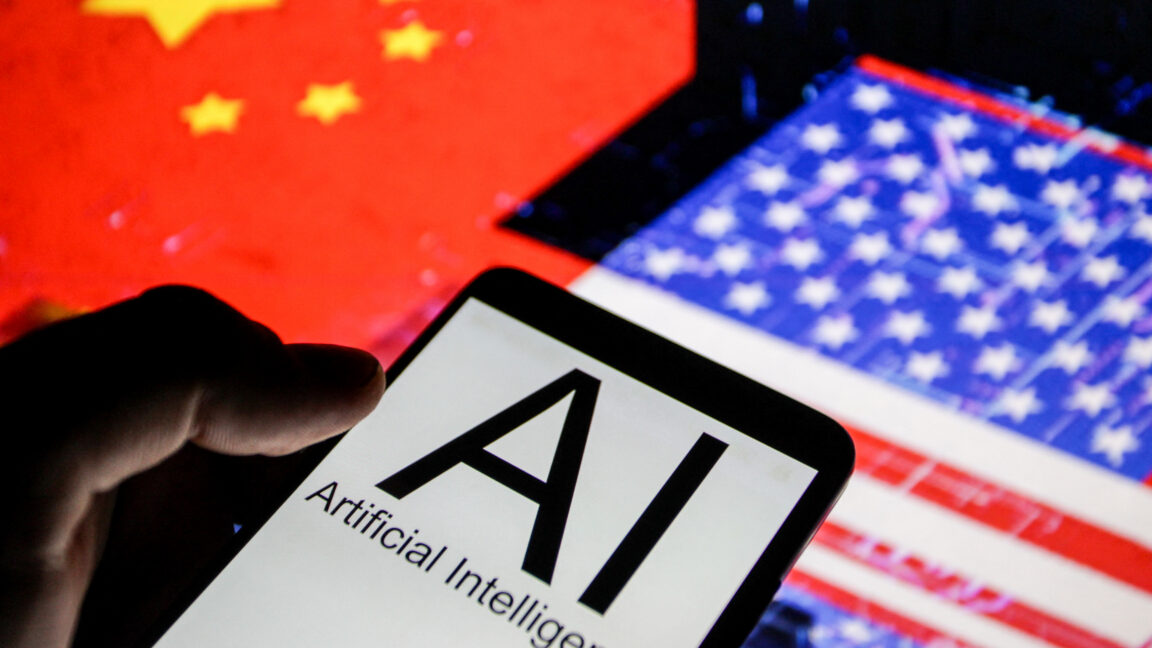
Exclusive: Paying for frontier AI models buys 4-month head start at 5x the cost
The performance gap between frontier AI models from US tech companies and the best open-weights models from Chinese companies has closed to just 4.4 months, according to a Mozilla report. That explains why many companies are shifting to the significantly cheaper open models for routine work—and helps reveal a narrow band of workloads where frontier models are worth the cost.
Most organizations should ideally be using open models as the default for the majority of their work, according to the latest State of Open Source AI report from Mozilla, published on September 15 and shared with Ars prior to publication. The report highlights how a leading open model, Moonshot AI’s Kimi K3, achieves a composite AI performance score on the Artificial Analysis Intelligence Index that is just three points behind Anthropic’s Fable 5 closed frontier model, all while costing just 30 percent of the latter.
“[A Closed model] earns its premium in a few places: expert professional work, high-intensity retrieval, and long context,” Raffi Krikorian, chief technology officer at Mozilla, said in an email to Ars. “We see the decision to pay for closed [models] as workload-specific rather than organization-specific.”


高瓴90后,成了梁文锋的CFO
(本文作者为 融中财经,钛媒体经授权发布)
文 | 融中财经
9月14日,一则人事消息在创投圈里传开。据多个独立信源,DeepSeek的首席财务官即将到岗,最接近最终人选的是高瓴创投合伙人严文韬,他目前已经在走离职程序。这个位子虽然还没有完全落定,圈内不少人已经默认了这件事。同一天,路透社也发出报道,称DeepSeek计划聘请这位高瓴创投合伙人出任公司首位CFO,报道里给他的标签是“dealmaker”,一个擅长做交易的人。
严文韬出生于1991年,今年35岁,此前一直在一级市场做投资。往前数一周,9月9日,DeepSeek聘请中信证券筹备科创板上市的消息刚刚得到知情人士证实。两件事前后脚发生,外界很难不把它们放在一起看。
一个空了一年半的位子
DeepSeek找CFO,找了很久。2025年2月,这家公司就在招聘信息里挂出了首席财务官、财务副总裁等岗位,职位描述里写着“优化资本结构”“推动战略融资”。那时R1刚刚在全球走红,市场的第一反应是,DeepSeek要开始融资了。
结果并没有。此后一年多,DeepSeek依旧靠幻方输血,CFO的位子也一直空着。直到今年6月,DeepSeek官网发布的财务团队招聘里,CFO依然在列,这个岗位一挂就是一年多。
位子空了这么久,想坐上去的人倒是一点不少。有信源透露,五源资本、红杉资本、龙珠资本等多家头部投资机构的负责人,都曾就这个岗位和梁文锋有过交流。这些名字放在任何一场投资峰会上,都是压轴的嘉宾。
业内对此的解读有些微妙。在不少人看来,这些“应聘”多半是个由头,真正的用意是借机和梁文锋坐下来聊一聊,摸一摸DeepSeek的底,顺便看看有没有投资机会。
毕竟在很长一段时间里,梁文锋都是中国AI圈最难约到的人之一,能和他面对面谈上一次,本身就是稀缺资源。一位行业人士说得很直白,这个岗位的吸引力,一半来自DeepSeek在行业里的位置,另一半来自它马上要走的资本化进程。坐上这把椅子的人,等于站到了中国AI眼下最大一笔资本故事的中间。
绕了一大圈,最后走到终点的是严文韬。据接近DeepSeek的人士透露,梁文锋希望这位CFO是个90后。这个条件听上去有些随性,却实实在在筛掉了一大批资历更深、年纪更长的候选人。
这个要求放在DeepSeek身上并不奇怪。这家公司的团队向来以年轻著称,有报道称其核心研究团队里30岁以下的人占了七成以上。
严文韬毕业于复旦大学,2020年加入高瓴创投,后来成为高瓴90后投资人的代表之一,不久前晋升合伙人。他投过的项目里,有字节跳动、极兔,也有智谱和MiniMax。后两家正是DeepSeek在大模型赛道上的同行,而且都已在港股挂牌。他从投资人的位置上,完整看过大模型公司怎么融资、怎么上市。路透社还特意提到,高瓴目前并不是DeepSeek的股东,他进门时不必背着老东家的利益。
与此同时,严文韬也不是从投资机构出走去大模型公司的先例。此前,高瓴MiniMax的投资人薛子钊在2023年就加入了MiniMax,担任投融资副总裁兼联席公司秘书。还有金沙江创投管理合伙人张予彤,在2024年4月加入月之暗面后担任总裁,负责包括融资在内的整体战略与商业化。
不止大模型圈,其他行业这样的例子还有很多。
很早之前,对投资人来讲成长到一定地步然后去自立门户,做新基金是人生目标。但现在,越来越多的投资人似乎更倾向于去创业或者去企业里做高管。
从不融资到两轮千亿
把时间拨回一年前,DeepSeek和“融资”两个字几乎扯不上关系。梁文锋公开表达过,DeepSeek缺的是高端芯片,而钱并不是问题。转折发生在今年春天。4月,The Information报道称DeepSeek正在寻求首次外部融资,规模至少3亿美元,估值不低于100亿美元。这个数字很快就被远远甩在身后。6月中旬,DeepSeek首轮融资落地,整体规模约510亿元,投后估值接近4000亿元,成了中国大模型史上规模最大的首轮融资。
出资名单里,梁文锋本人拿出约200亿元,是最大的单一出资方。腾讯出资约100亿元,宁德时代体系约50亿元,网易、京东、IDG资本等也在其中,国家人工智能产业投资基金出资近10亿元。互联网大厂、产业资本和老牌美元基金,都挤进了这一轮。
比数字更耐人寻味的是条款。据知情人士透露,除了国家人工智能产业投资基金直接注资,其余外部投资方的钱都要先进入一个由梁文锋管理的有限合伙企业,再间接持有DeepSeek的股份。这些投资人没有投票权,拿不到董事会席位,还要接受五年锁定期,换来的主要是优先获取财务信息和后续轮次的优先认购权。
梁文锋团队甚至要求核查每一只出资基金背后的LP是谁。融资之前,梁文锋先通过增资把个人直接持股从1%提到34%,叠加间接持股后,最终受益股份达到84.29%,表决权则是百分之百。
有评论把这轮融资形容为买了一张后排座位的票,钱可以出,方向盘却始终握在梁文锋手里。换作别的公司,这样的条件大概很难谈得下来。即便如此,想上车的人依旧排着队,连腾讯这样的巨头也坐进了后排。
第二轮来得更快,也更曲折。7月中旬,DeepSeek启动第二轮融资,没过多久却突然按下暂停键,一些排在候补名单上的投资人被告知签约计划暂缓。据媒体报道,原因之一是梁文锋对网上流传的一份“投资者交流会实录”感到不满。那场交流会持续了将近4小时,内容后来在业内被大量转发。8月初,融资重启,计划募资500亿元,投前估值约5000亿元,原定8月下旬签约,这一次双方都希望尽量低调。截至目前,这轮融资的最终落地情况还没有公开消息。
这次暂停把双方的分歧摆到了台面上。往后在两者之间来回传话、拿捏分寸的,大概就是这位新CFO了。这份差事,比单纯去谈一笔融资难得多。
钱的问题背后,还连着人的问题。过去DeepSeek迟迟不融资,员工手里的期权没有外部估值作参照,到底值多少很难说清。
与此同时,大厂的挖角一直没停,罗福莉去了小米,王炳宣去了腾讯,R1核心研究员郭达雅在今年4月被证实加入字节跳动Seed团队。当然也有不同的声音,《财经》梳理了DeepSeek两年多来27篇论文的作者名单,认为这支团队的核心成员其实相当稳定,队伍还在扩张。不管怎么看,股权一旦有了清楚的价格,留人这件事总归会好办一些。
科创板在等一个大模型
6月17日,证监会主席吴清在陆家嘴论坛上宣布,科创板第五套上市标准的适用范围扩大到人工智能大模型领域。当天下午,上交所就发布了配套的审核指引,前后只隔了几个小时。这一天,被不少人看作大模型公司登陆A股的起点。
这份指引共十五条,核心意思是支持那些还没有形成一定收入规模、但技术优势明显的大模型企业到科创板上市。门槛也写得清楚,其中一条要求企业在申报时,至少有一个大模型产品已经上线发布并实现规模化应用。拿这条对照DeepSeek,几乎不需要额外准备,R1之后它在全球开发者中的影响力有目共睹,V4系列也延续着开源和迭代的节奏。此前科创板上的AI公司,以摩尔线程、沐曦这类芯片企业为主,纯粹做大模型的公司,这条路还是头一回被明确打开。
DeepSeek的动作跟得很紧。据彭博社报道,早在7月,DeepSeek就在和会计师事务所、投行顾问合作,准备上市需要的财务材料。那时外界的目光还集中在第二轮融资上,上市的准备工作已经在暗处铺开了。
9月9日,路透社援引知情人士称,DeepSeek已聘请中信证券筹备科创板IPO,希望年内启动上市流程。相关媒体随后从知情人士处证实了这个消息,中信证券已经进场做尽职调查,只是双方还没签正式的上市辅导协议,上市时间、募资规模和发行估值也都没有定。另有报道提到,DeepSeek今年前7个月营收约4.75亿元,差不多是2025年全年的10倍。同一天,DeepSeek还下调了Flash系列模型的API价格,有分析认为,这是在用降价换调用量。
按照路透社的说法,CFO在一家公司里管的是投资者关系、财务内控、资本配置,以及上市所需的信息披露。这些事,恰恰是DeepSeek过去碰得最少的。对一家习惯关起门来做研究的公司来说,这几乎是一套全新的语言。
这家公司的沉默是出了名的。梁文锋在2024年7月接受暗涌Waves采访之后,将近两年没有再公开发声,研究员们也很少在公开场合露面。V4发布时,面对外界的种种议论,DeepSeek的回应只有一句“不诱于誉,不恐于诽,率道而行,端然正己”。可一旦成为上市公司,定期财报、临时公告、业绩说明会都会接踵而至。开源和商业化之间的关系怎么讲,也是招股书里绕不过去的一章。模型被广泛使用,并不直接等于收入,这一点总得有人向二级市场的投资者解释明白。
同行们在这件事上走得更早。MiniMax的投融资副总裁兼联席公司秘书薛子钊,同样出身高瓴资本,在公司里负责资本市场运作和财务事务。MiniMax从一级市场一路走到港股挂牌,这一环始终有专人盯着。
月之暗面那边,前金沙江创投管理合伙人张予彤以联合创始人身份加入,负责融资等事务,去年底前后以总裁身份公开亮相。杨植麟当初评价她,既懂业务和战略,又有丰富的投融资经验,还愿意走出舒适区去冒险。如今月之暗面已秘密递交赴港上市申请,据《南华早报》报道,它还在考虑之后再登陆科创板。智谱和MiniMax则已先后在港股挂牌,走在了前面。从投资机构走进大模型公司管钱,这条路早有人走通,严文韬并不是第一个。
在今年那场4小时的投资者交流会上,梁文锋说,DeepSeek最大的核心利益是保持团队稳定。克制了三年的DeepSeek,如今要去推资本市场的那扇门。门后是什么样子,这位90后CFO很快就会亲眼看到。
更多精彩内容,关注钛媒体微信号(ID:taimeiti),或者下载钛媒体App

华为小艺 Work 开启内测:鸿蒙手机、平板、电脑全打通,支持办公、代码、设计多种 AI 任务
IT之家 9 月 16 日消息,华为宣布小艺 Work 开启内测。该服务定位为面向日常办公、代码开发和创意创作的 AI 工作助理,支持鸿蒙手机、平板和电脑。
华为现已在官网提供 Windows 客户端下载,版本号 0.6.9。鸿蒙电脑用户可打开小艺 App,在左侧边栏切换至“工作”,预约鸿蒙版小艺 Work。
据介绍,小艺 Work 可接收用户目标,自主拆解任务、安排步骤、调用工具并推进执行。任务进度可查看,关键节点由用户审核。
该服务支持手机、平板与电脑跨端协同,用户可通过移动设备远程下发任务、查看进度并验收结果。执行环境支持云电脑与本地电脑,按任务所需软件、文件和工作环境选择。
官方称,小艺 Work 可根据需求自动匹配专家协同工作,覆盖研究分析、内容创作、编程办公等场景。手机端连接电脑后,可远程继续任务、接收进度提醒,并调用电脑上的文件和工具。
在任务接续方面,电脑上的任务持续运行,用户离开电脑后可用手机继续跟进。任务完成后,文件与处理结果自动同步。
用户可实时查看电脑上的工作进度,并支持同时连接多台电脑。华为给出的示例包括优化项目汇报 PPT 并提炼重点、优化核心函数逻辑并补充代码注释、设计活动视觉海报并统一配色风格。

小艺 Work 会员服务协议显示,会员权益包括 AI 点数等。不同功能因任务复杂度不同,消耗的 AI 点数存在差异,以实际用量为准,每日消耗明细可在权益记录中查看。IT之家注:AI 点数是该服务中用于计量任务消耗的虚拟额度。
协议显示,付费订阅会员服务失效后,数据将保留 7 天,7 天内续费可恢复,逾期删除且不可恢复。通过体验活动等免费获取的会员服务失效后,如未及时付费订阅,数据将立即自动删除且不可恢复。
隐私声明显示,智能对话会收集设备信息、应用基本信息、系统属性、华为账号信息,以及用户主动上传的文件、视频、音频、图片、文本和文档等,相关内容会在服务器上加密保存。
远程协同和记忆功能也会处理类似信息。记忆功能会总结对话中提及的关键信息,包括个人偏好、行程信息、家庭成员信息、工作信息等,用于跨会话记忆和多端同步。华为表示,上述记忆数据不会用于模型训练。
设备权限方面,系统剪贴板读取、本地文件读取和麦克风权限均为可选。拒绝剪贴板权限将无法在智能对话中粘贴内容,拒绝本地文件权限将无法处理本地文件任务,拒绝麦克风权限将无法使用语音输入。
备案信息显示,小艺 Work 涉及生成合成类算法包括 DeepSeek 大语言模型算法、华为云盘古 NLP 大模型算法、MiniMax 应事文本信息合成算法、智谱交互式内容生成算法和月之暗面 Moonshot 语言模型算法。
Similar Accuracy, Unequal Evidence: Search APIs as Decision Surfaces for Tool-Using Agents
CRAF: Cross-View Residual-Aware Fusion for Deepfake Speech Detection
RSIAgent: Autonomous Exploration for Recursive Self-improvement in New Environments
The average-farmer illusion in language-model simulations of agricultural decisions

State of Open Models: Summer 2026 Observations
Why Regulated Enterprises Need Risk-Tiered Model Routing
AI is getting cheaper at the same time that companies are spending more on it. That sounds contradictory, but it is one of the most important things happening in enterprise AI right now.
The price of processing a million tokens keeps falling, especially as open-weight models improve and compete aggressively on cost. At the same time, enterprises are moving from small pilots to always-on copilots, automated workflows and multi-step agents. Cheaper units make it easier to use more units.
For insurance and financial services, I think this changes the AI conversation in a useful way. The question is no longer which single model should win. The better question is which model should handle which kind of work, at what reliability level and under what governance rules.
Tokenomics Is Becoming a Real Operating Discipline
I use tokenomics to describe the economics of AI at the unit level. Every prompt, retrieved document, tool response and generated answer consumes tokens. Once AI moves into production, those tokens stop being an abstract engineering metric and become a recurring operating cost.
Pricing is also becoming more complicated than a simple monthly subscription. Many enterprise deployments now combine usage-based pricing, committed capacity, caching discounts and different rates for input and output. A team can have a cheap model and still end up with an expensive system if prompts are bloated, agents loop unnecessarily or every task is routed to the most capable model by default.
That is why lower token prices do not remove the need for cost governance. They actually make governance more important because falling prices encourage more experimentation and more volume.
The Open-Weight Shift Is Bigger Than One Model
The most interesting part of the current market is that the pressure is not coming from one challenger. It is coming from an ecosystem of open-weight models that keeps improving. Families such as DeepSeek, Qwen, Kimi, GLM and MiniMax have made it harder to assume that the best enterprise option must always come from a closed frontier provider.
That pressure is visible in pricing. In May 2026, DeepSeek made a 75 percent reduction on its flagship V4-Pro pricing permanent [1]. The exact leaderboards will continue to move, but the broader direction is clear: strong models are becoming available at much lower unit costs than many teams were planning around a year ago.
For enterprises, this creates something closer to a portfolio market. Instead of asking one model to do everything, teams can route work based on task difficulty, latency needs, data sensitivity and the cost of being wrong.
The Cheapest Token Can Still Be the Most Expensive Decision
This is where regulated industries need a different lens from consumer experimentation. Insurance and financial-services workflows often involve underwriting, claims, customer communications, compliance reviews and other decisions where a small quality gap can create a large downstream cost.
Reliability becomes especially important in agentic workflows. If a model succeeds 95 percent of the time at each step, a five-step workflow succeeds end to end only about 77 percent of the time. Each step may look strong in isolation, yet the combined workflow can still fail often enough to create rework, manual review and customer friction.
That is why I do not think the right strategy is to route everything to the cheapest model. A cheaper model may be perfect for summarization, classification, drafting or high-volume internal tasks. A higher-cost model may still be worth the premium when a workflow is complex, regulated or difficult to recover from when it fails.
A Better Model Strategy Looks Like Routing
The enterprise AI stack is starting to look less like a single vendor decision and more like a routing problem. The goal is to match model capability to business risk. I call this approach a risk-tiered model routing framework: work is classified by business risk first, and model choice follows from that classification rather than the other way around.
Routine work can often go to smaller or open-weight models. Medium-risk tasks can use stronger models with additional checks. High-impact decisions can be routed to the most reliable model available and paired with human review, deterministic rules or independent verification.
This is not only about saving money. Routing gives teams a way to make cost and reliability explicit. It forces product leaders to define which tasks actually require frontier-level capability instead of paying the reliability premium everywhere.
In my own work leading AI product strategy for large financial-services and insurance organizations, this kind of tiering plays out in practice. Routing high-volume, low-risk tasks such as document summarization, intake classification and internal drafting to smaller or open-weight models has meaningfully reduced inference cost without a measurable drop in output quality, while tasks tied to underwriting judgment, compliance communications or customer-facing decisions have continued to justify a reliability premium, paired with human review. The savings from the first category are what fund the ability to be conservative in the second.
Open Weights Also Change Vendor Risk
Cost is only one reason open-weight models matter. They can also change how organizations think about continuity and control. A model that can be deployed in more than one environment gives a team options if a hosted service becomes unavailable, changes terms or becomes difficult to use in a particular jurisdiction.
That became more than a theoretical concern in 2026, when a U.S. export-control action temporarily suspended access to certain frontier AI models worldwide [2]. Whatever your view of those policies, the engineering lesson is straightforward: dependency on a single model endpoint is now a business-continuity question.
For regulated companies, model provenance belongs in the same conversation. Teams need to know where a model came from, what license applies, how it was trained or fine-tuned when that information is available, where inference runs and who is responsible for monitoring changes. Open does not automatically mean low risk, just as closed does not automatically mean safe.
FinOps for AI Needs to Start Before the Bill Hurts
Traditional cloud FinOps taught teams to track compute, storage and network consumption. AI needs a similar discipline, but token count alone is not enough.
I would track cost by use case, model, workflow and outcome. A workflow that costs twice as much but cuts manual review dramatically may be the better investment. Another workflow may look cheap per call but become expensive because it runs millions of times or repeatedly retries failed steps.
Teams should also watch prompt size, retrieved context, output length, cache hit rates and the number of model calls inside one user action. Those are the places where an apparently small design decision can quietly multiply production cost.
Falling Prices Will Probably Increase Total Spend
There is a larger paradox here. AI infrastructure spending continues to rise even while inference prices fall. That makes sense if cheaper AI unlocks more use cases, more users and more automation.
A team that once used AI for one chatbot may now use it for document processing, customer support, coding, rese
Should US Open-Weight AI Labs 'Distill' Frontier Models Too?
Read more of this story at Slashdot.