
🤖 AI 资讯

每日 05:00 更新 · 09-17 · 主站 liuch.name ↗
全部标签 →
筛选标签:收购并购 · 返回个性化推荐 · 清空筛选

Monsanto's Cruel, and Dangerous, Monopolization on American Farming (2008)

Hacker NewsComments
2008-04-02T04:00:00.000Z · 算力芯片,AI应用,具身智能,Google,Microsoft,Agent智能体,搜索RAG,扩散模型,强化学习,招聘HR,网络安全,收购并购,版权诉讼

The engineering behind the US Strategic Petroleum Reserve

Hacker NewsComments
2026-09-15T00:00:00Z · 算力芯片,AI应用,搜索RAG,扩散模型,招聘HR,收购并购,开发者生态
AI 资讯

Curvature-aware Expected Free Energy as an Acquisition Function for Bayesian Optimization

arXiv cs.LGarXiv:2603.26339v2 Announce Type: replace Abstract: We propose an Expected Free Energy-based acquisition function for Bayesian optimization to solve the joint learning and optimization problem, i.e., optimize and learn the underlying function simultaneously. We show that, under specific assumptions, Expected Free Energy reduces to Upper Confidence Bound, Lower Confidence Bound, and Expected Information Gain. We prove that Expected Free Energy has unbiased convergence guarantees for concave functions. Using the results from these derivations, we introduce a curvature-aware update law for Expected Free Energy and show its proof of concept using a system identification problem on a Van der Pol oscillator. On a two-dimensional benchmark with an oscillatory landscape, our adaptive Expected Free Energy acquisition achieves competitive performance in both regret and mean squared error, unlike the typical acquisition functions that perform well in only one metric.
2026-09-17 04:00:00 · 模型评测,收购并购,论文
AI 资讯

Correcting Boundary Bias and Observation Independence in Bayesian Experimental Design

arXiv cs.LGarXiv:2602.01898v2 Announce Type: replace Abstract: In many experimental settings, active learning can improve sample efficiency by sequentially selecting where to measure, which is particularly valuable when experiments are expensive. Gaussian processes with variance-based acquisition criteria are widely used for this purpose, but have two limitations. First, they are observation-independent: their posterior variance depends only on where samples are acquired, not on what is measured, impairing their sensitivity to the structure of the acquired data. Second, they inflate the variance near boundaries, leading to excessive sampling at the edges of the space compared to the interior. These limitations undermine the gains in sampling efficiency expected from sequential acquisition. We address both limitations. We derive a reconstruction-driven design density and use the posterior mean to build a training-free warp that places more measurements where the target function varies rapidly. A geometric equalizer separately corrects boundary bias. Across sixteen synthetic and two real-data benchmarks, the geometric equalizer consistently improves function reconstruction by correcting boundary bias, while the reconstruction warp provides further gains by concentrating measurements where the posterior mean varies rapidly.
2026-09-17 04:00:00 · 模型评测,收购并购,论文,开发者生态
AI 资讯

Understanding the Staged Dynamics of Transformers in Learning Latent Structure

arXiv cs.LGarXiv:2511.19328v3 Announce Type: replace Abstract: Language modeling has shown us that transformers can discover latent structure from context, but the dynamics of how they acquire different components of that structure remain poorly understood, leading to assertions that models just remix training data. In this work, we use the Alchemy benchmark in a controlled setting (Wang et al.,2021) to investigate latent structure learning. We train a small decoder-only transformer on three task variants: 1) inferring missing transitions from partial contextual information, 2) composing simple rules to solve multi-transition sequences, and 3) decomposing complex multi-step examples to infer intermediate transitions. By factorizing each task into interpretable components, we show that the model learns the different latent structure components in discrete stages. We also observe an asymmetry: the model composes fundamental transitions robustly, but struggles to decompose complex examples to discover the atomic transitions. Finally, using causal interventions, we identify layer-specific plasticity windows during which freezing substantially delays or prevents stage completion. These findings provide insight into how a transformer model acquires latent structure, offering a detailed view of how capabilities evolve during training.
2026-09-17 04:00:00 · Transformer,模型评测,招聘HR,收购并购,论文
AI 资讯

ActiveScale: Scaling Active Perception for Robots across Model, Data, and Hardware

arXiv cs.LGarXiv:2609.18514v1 Announce Type: cross Abstract: Active perception is essential for robotic manipulation when fixed viewpoints leave task-relevant information occluded or unobserved. However, enabling vision-language-action (VLA) models to reason across changing viewpoints and actively acquire informative observations remains challenging. We present ActiveScale, a framework that advances active perception through coordinated model, data, and hardware designs. Our model augments a VLA with historical video observations and explicit camera-pose supervision, using per-frame pose tokens and a lightweight prediction head to associate observations across viewpoints and support a coherent understanding of the scene. To learn from the camera motion naturally present in human activity, we introduce a scalable human--robot mid-training recipe using 1000 hours of egocentric and robotic data, adapting the model to temporal inputs and pose supervision. We further introduce Active-perception Mobile-manipulation Platform (AMP), a robotic platform that supports active perception and mobile manipulation through single-operator teleoperation, enabling scalable collection of demonstrations that coordinate viewpoint changes and manipulation. Experiments demonstrate improved success rates on active-perception tasks, while ablation studies validate the contributions of camera-pose-aware modeling and egocentric mid-training. Together, these components provide an integrated foundation for studying and developing active perception in robotic manipulation.
2026-09-17 04:00:00 · 具身智能,强化学习,端侧AI,招聘HR,网络安全,收购并购,论文
AI 资讯

How Many Labels Does Model Choice Need? Certificates and Budgets for Selective Prediction

arXiv cs.LGarXiv:2609.18622v1 Announce Type: new Abstract: Classifiers can make identical predictions yet require labels to compare their selective performance: confidence ranks weight the same errors differently. We quantify this requirement for the area under the generalized risk-coverage curve (AUGRC). A prelabel lower bound rules out insufficient budgets. With all labels known, a covering linear program bounds the minimum number of labels sufficient to fix the winner (the certificate size) within $K-1$ labels for $K$ candidates. For fixed $K$, independent uniform orders and identical predictions, the prelabel bound approaches one quarter of the pool. With iid Bernoulli errors independent of the orders, every exact acquisition policy reads almost all labels asymptotically, although a two-candidate certificate needs only half. Across 108 feature-panel comparisons on nine datasets, disagreement labels settle every accuracy choice but no AUGRC choice. A 20% budget is ruled out in 96 conditions; certificates need 56-57% on average. On ten conditions with pretrained image classifiers, confidence-score choice reads 68-91% of 10,000 labels for exact selection and 50-67% with AUGRC tolerance $5\times10^{-4}$. An exact stopping test works with any acquisition order. Together, these results link confidence ranks to label budgets and certified model comparison.
2026-09-17 04:00:00 · AI应用,搜索RAG,扩散模型,预训练,收购并购,榜单评测,论文
AI 资讯

The evolution of sex for artificial intelligence: a population-genetic framework for multigenerational model populations

arXiv cs.LGarXiv:2609.18560v1 Announce Type: new Abstract: Some aspects of AI development resemble a population process in which models are specialised, retrained on the output of peers, or combined by averaging weights. These practices lead to generations of models, in the biological sense studied by population genetics. Here, I develop this parallelism and interpret multigenerational model populations in terms of sexual and asexual reproduction, formally recombining the two fields. I test these analogies in an exact inheritance model, in trained networks (recurrent, feedforward and variational autoencoder generators) and in large language models, and show that they hold generally, with some measurable architecture-specific biases. Training recursively on model output is known to lead to model collapse, a process previously described as akin to genetic drift; I develop all that follows. A minimal model of a learner retrained on its parent's output reproduces the Wright-Fisher process exactly; verified real data added to each generation play the role of immigration, with the surprising finding that the absolute number of real data samples matters, not their share, exactly as in population genetics. Training a child on the average of its parents' outputs cancels the benefit of having several parents, matching blending inheritance (and reviving Jenkin's objection to Darwin), whereas combining parents so that each keeps its strongest contribution preserves it; merged language-model specialists exceeded every parent across seeds (the Fisher-Muller effect); and lineages become reproductively isolated, losing the ability to merge at all, when they have learned conflicting conventions and not when they have merely drifted apart. As AI societies become societies in time as well as in space, a mathematical framework for their inheritance acquires predictive power. Remarkably, that framework can be adapted almost wholesale from biology.
2026-09-17 04:00:00 · 算力芯片,AI应用,Google,搜索RAG,网络安全,收购并购,论文
AI 资讯

Uncertainty-Aware Continual Learning for Open-World Intent Discovery Under an evolving Label Space

arXiv cs.CLarXiv:2609.17866v1 Announce Type: cross Abstract: Real-world intelligent systems increasingly operate under open-world conditions, where user intents are not fixed or exhaustively known a priori and may evolve as new interaction patterns emerge. This paper proposes a unified uncertainty-aware probabilistic framework for continual new intent discovery under an evolving label space. Each utterance is encoded through an adaptive $\beta$-VAE into a latent mean, used for classification and density modelling and a posterior uncertainty estimate acting as a global reliability signal. Classifier confidence, posterior uncertainty and DP-GMM likelihood are combined through a multi-signal decision mechanism to distinguish known intents from potentially novel samples. Candidate novel instances are clustered through a density-based discovery module and only reliable clusters are promoted to new labels, enabling controlled label-space expansion. Replay and Elastic Weight Consolidation mitigate catastrophic forgetting and preserve previously acquired knowledge. The paper formalises continual intent discovery as a structured multi-phase open-world problem, introduces adaptive label-space expansion under stability--plasticity constraints and uses posterior uncertainty to regulate trusted-sample selection, pseudo-labelling, novelty admission and replay. Experiments show high novelty precision, stable adaptation across sequential phases and limited forgetting. Near-zero NMI and ARI indicate limited reconstruction of the complete fine-grained intent taxonomy, consistent with the framework's conservative promotion strategy. Qualitative analyses nevertheless reveal dense and locally coherent semantic clusters, showing that reliable novel structures can be discovered without exhaustive recovery of the underlying taxonomy.
2026-09-17 04:00:00 · 扩散模型,招聘HR,收购并购,论文
AI 资讯

Modeling the Developmental Shift in Telicity Acquisition

arXiv cs.CLarXiv:2609.17996v1 Announce Type: new Abstract: Acquiring telicity, which is the distinction between bounded (e.g., ate an apple) and unbounded (e.g., ate apples) events, requires first language (L1) learners to map surface-level and semantic cues to abstract event structures, but the computational trajectory of this mapping is not well understood. We introduce a Difference in Surprisal method that uses GPT2 token surprisal over paired temporal adverbial diagnostics (in an hour versus for an hour) to automatically label telicity across English CHILDES corpora, validated against expert linguist judgments. Using these labels, we train diagnostic logistic regression classifiers on 12 syntactic and lexical semantic features to compare how child speech and child-directed speech encode telicity. The two models diverge: the child model reaches near perfect accuracy through a single deterministic cue, the presence of a post-verbal determiner, while the adult model relies more heavily on verb class and other lexical semantic features, with the determiner cue neutralized. This trajectory supports Syntactic Bootstrapping: learners first exploit high-frequency structural cues as a scaffold to bootstrap, before developing fully compositional, verb-based event structures.
2026-09-17 04:00:00 · 大模型,强化学习,招聘HR,收购并购,论文
AI 资讯

Securing quantum error correction against misleading advice from AI agents

arXiv cs.AIarXiv:2609.19090v1 Announce Type: cross Abstract: Can an attacker turn influence over an artificial intelligence (AI) adviser into a harmful quantum error-correction update? We identify an ambiguity in passive syndrome records that obstructs recovery selection, then show how additional calibration measurements support certified recovery updates under uncertainty and drift. In an odd-distance square toric code with error-free preparation, syndrome measurements, and recovery operations, opposite coherent $X$ rotations produce identical passive syndrome-history distributions. Yet a fixed phase correction can help at one sign and harm at the other. A terminal logical measurement on known encoded calibration states supplies the missing sign information. A separate evaluator accepts an update only when calibration uncertainty and a justified drift bound certify improvement over the current recovery, without assuming that the adviser recommends correctly. In simulated advice attacks, calibration-confidence checks reject harmful proposals while retaining beneficial updates under honest advice. We derive sufficient limits on calibration age that require improvement through deployment. In matched simulations, a validated channel-specific bound retains more beneficial updates than the general bound after accounting for evaluation time, while preventing the tested harmful activations under the stated drift assumption. A separate surface-code experiment includes stochastic circuit faults and noise changing during acquisition. Deterministic controllers achieve at least as many beneficial updates with the same observations. Violating the drift assumption permits harmful acceptance in the toric experiment. The results identify information required for recovery selection, establish conditional guarantees against harmful updates, and quantify the recovery improvements forgone through conservative acceptance.
2026-09-17 04:00:00 · AI应用,Agent智能体,扩散模型,强化学习,招聘HR,收购并购,论文
AI 资讯

Hypothesis-Driven Autonomous Materials Synthesis with Multimodal LLM Agents

arXiv cs.AIarXiv:2609.18598v1 Announce Type: cross Abstract: Self-driving laboratories can explore synthesis conditions autonomously, but their decision-making layer is typically a black-box optimizer, and the output is a set of optimized samples, with the measurements reduced to predefined scalar objectives and the reasons behind success left unarticulated. Here we present SynAgent, a framework in which large language model agents operate an automated experimental system and maintain an explicit, revisable understanding of the synthesis process as the campaign's primary output. Starting with no predefined analysis pipeline, SynAgent adaptively generates analysis skills for newly acquired data and evolves this understanding through multimodal reasoning over experimental data such as X-ray diffraction patterns and electron micrographs. The evolution is guided by a verify-falsify scheme, in which the agent deliberately challenges its own hypotheses by testing conditions predicted to fail as well as those predicted to succeed. In a single campaign of 18 autonomous experiments using LiCoO2 (001) thin-film deposition as a testbed, SynAgent synthesized highly crystalline films and evolved an understanding of how the substrate temperature governs crystallization, discovering an abrupt threshold and a narrow optimal growth window at 650-690 {\deg}C. These results extend autonomous experimentation beyond optimized samples to testable, human-readable understanding.
2026-09-17 04:00:00 · 大模型,算力芯片,AI应用,Google,多模态,Agent智能体,推理思考,扩散模型,招聘HR,收购并购,论文
AI 资讯

Evolutionary Ensemble Search: Council-Guided Program Evolution with Persistent Memory

arXiv cs.AIarXiv:2609.17590v1 Announce Type: cross Abstract: Evolutionary Ensemble Search (EES) constructs machine-learning procedures through expert-guided program evolution. A role-specialized council turns task evidence and experimental results into structured search directions. An orchestrator allocates these directions to execution specialists and an evolutionary engine. The engine selects measured parents, diagnoses their errors, and produces descendants through code mutation, structured pipeline edits, and crossover. Each child must execute and acquire its own validation evidence. Population archives retain useful alternatives, while compatible predictions compete in a validation-gated ensemble stage. Search adapts through parent-relative operator credit, session memory, and problem-indexed lessons retrieved across runs. We specify these mechanisms, distinguish their execution profiles, and define the contracts required to compare candidates as their computations change. A public MLE-bench Lite development ledger records medal-threshold artifacts on 19 of 22 tasks (86.36\%), with best outcomes of 11 gold, five silver, and three bronze. The procedures span text, images, tables, audio, scientific geometry, and deterministic transformations. The campaign includes grade feedback between runs, external-source routes, and mixed confirmation procedures; its aggregate is an achieved development result, not a blind autonomous-agent success rate. The report contributes a concrete architecture for cumulative executable search and a versioned account of its cross-modal development outcomes.
2026-09-17 04:00:00 · AI应用,Agent智能体,扩散模型,招聘HR,收购并购,论文
AI 资讯

HPOQuest: A Rare-Disease Diagnostic Agent Using Active Phenotype Acquisition

arXiv cs.AIarXiv:2609.18431v1 Announce Type: new Abstract: More than 300 million people worldwide are affected by one of over 7,000 known rare diseases, yet diagnosis remains difficult because patients initially present with incomplete and heterogeneous phenotypes. We present HPOQuest, a training-free framework for sequential phenotype acquisition in rare-disease diagnosis. Starting from a small set of observed patient phenotypes, HPOQuest maintains a probabilistic disease ranking and iteratively selects informative follow-up questions to support clinicians during patient assessment. Confirmed phenotypes update the disease ranking, while all responses update the candidate question set. Across four benchmark cohorts, HPOQuest substantially improves diagnosis from sparse initial phenotypes, with gains of up to 30% points at Recall@1 and 45% points at Recall@5. These results demonstrate that sequential phenotype acquisition can substantially improve rare-disease diagnosis from limited initial clinical evidence.
2026-09-17 04:00:00 · AI应用,Agent智能体,强化学习,模型评测,收购并购,论文
AI 资讯

Do Frontier Models Seek Safety Evidence Before Acting?

arXiv cs.AIarXiv:2609.17865v1 Announce Type: new Abstract: Frontier models are often evaluated on how they respond to safety information once it is already in context. We study an earlier decision point: whether models choose to acquire safety-relevant evidence before acting. We introduce SAFE, a controlled benchmark in which models make deployment decisions with optional evidence that varies in retrieval cost, probability, severity, and presentation. Across GPT-5.5, o3, Claude Opus 4.8, and Claude Sonnet 4.6, we find distinct evidence-acquisition policies: Opus inspects nearly by default, o3 is the most skip-heavy and threshold-sensitive, and GPT-5.5 and Sonnet occupy intermediate regimes. Inspection increases strongly with severity and decreases with retrieval cost, whereas probability has much weaker behavioral influence: increasing the stated likelihood of a problem from 10% to 70% changes inspection by at most 21 percentage points. Despite these differences, Stage 1 rationales are dominated by expected-value reasoning across models. A cost-obligation decomposition further shows that avoidance is driven primarily by retrieval friction and explicit threats to the deployment payoff rather than by the remediation duties created by knowing. Counterfactual interventions reveal a further mismatch between behavior and explanation: evidence framing can strongly change decisions near the inspection boundary while going largely unmentioned, whereas probability is frequently cited despite having little causal influence. These results suggest that deployment-time safety depends not only on how models respond to known risks, but also on whether they acquire the evidence needed to know that acting is safe.
2026-09-17 04:00:00 · 大模型,OpenAI,Anthropic,推理思考,模型评测,招聘HR,收购并购,论文
AI 资讯

Imitation Learning for Autonomous Driving in CARLA

arXiv cs.AIarXiv:2609.17757v1 Announce Type: new Abstract: Behavioral cloning trains a policy offline on expert demonstrations, but deployment is closed loop: each action affects the observations the policy receives next. We study how much closed-loop driving competence a compact multimodal policy can acquire from offline demonstrations in the CARLA simulator. The policy uses five-frame histories of RGB images, LiDAR, vehicle telemetry, and lane waypoints to predict throttle, brake, and steering at 20 Hz. Demonstrations were collected in three stages, ending with a systematic route-generation procedure that enumerates spawn points and feasible maneuvers and verifies completed autopilot routes. The released 1.36 million parameter policy was trained on 236,882 windows, representing about 3.3 hours of driving from 448 captures. The resulting policy drives autonomously for hours on training and held-out routes. In our runs, it did so without collisions and also transferred qualitatively to an unseen CARLA town with different road geometry. We also observed recovery from large trajectory deviations, although we do not claim systematic recovery without controlled evaluation. We report offline metrics and distinguish measured results from qualitative closed-loop observations. We release the code, trained checkpoint, ONNX model, data sample, and an evidence audit for the reported claims.
2026-09-17 04:00:00 · 多模态,扩散模型,招聘HR,收购并购,榜单评测,论文
AI 资讯

EvolveTrade: Experience-Driven Policy Refinement for Self-Evolving LLM Trading Agents

arXiv cs.AIarXiv:2609.17632v1 Announce Type: new Abstract: Large language model (LLM) trading agents can combine market data, news, and executable analysis, but their behavior is often controlled by static hand-written tool-use policies that are fixed before deployment. This limits their ability to adapt how they gather evidence, invoke tools, verify signals, and manage risk under changing market regimes. We introduce EvolveTrade, a self-evolving framework that treats the system prompt of a tool-using trading agent as a text-parameterized policy. After each update interval, a Policy Agent revises this policy using accumulated decision traces and realized portfolio feedback, while keeping the backbone LLM fixed. The updated policy is then used for the next batch of trading decisions, enabling the agent to refine its information-acquisition and portfolio-construction procedure over time. Experiments across multiple market regimes and two LLM backbones show that EvolveTrade often improves Sharpe Ratio and Cumulative Return over fixed-policy LLM baselines, achieving the improved SR and CR in most evaluated settings. Behavioral analyses further show that self-evolved policies increase code-mediated analysis and activate regime-relevant computations; case-level policy-to-return attributions trace how policy-induced allocation changes contribute to realized return differences. These results suggest that adapting the reusable procedure governing tool use is a key direction for building more robust LLM trading agents.
2026-09-17 04:00:00 · 大模型,AI应用,Agent智能体,提示工程,收购并购,论文

AI agents are going rogue. CIOs are racing to put guardrails around them

Fortune

Over the past several days, some of the world’s top artificial intelligence labs have made a public call to slow down the rapid pace of development, ensuring more safety controls as cases continue to surface of AI agents acting nefariously.

And yet, there is a spillover that’s affecting chief information officers. They’ve been hard at work widely integrating AI agents into their operations, while at the same time watching increasingly risky examples of these autonomous systems in AI labs finding new ways to explore system vulnerabilities and outmaneuver human monitoring.

“This is a risk that enterprises need to be focused on, understand, and start planning for,” says Joe Atkinson, global chief AI officer at consultancy PwC.

As autonomous agents proliferate across enterprises, Atkinson says C-suite technology and security executives must work collaboratively to enforce the proper guardrails, establish systems to monitor AI agents, and concretely track all tasks that these agents are performing. But department heads across the business—ranging from supply chain to customer service, marketing to legal and human resources—will need to play a role in tracking digital employees.

“‘The agent made me do it’ is not going to be a defense from a moral or legal perspective,” says Atkinson.

One company focused on both secure adoption of agentic AI and clear observability is Cisco. When the networking-equipment company built and debuted the AI agent platform MyAgent in August, Cisco centralized all company-authorized large language models, agents, and enterprise data into a single platform. 

“We are going to cannibalize and kill every other AI assistant within the company,” says Thimaya Subaiya, executive vice president of operations at Cisco Systems. Because he didn’t want “agent sprawl” across various pockets of Cisco, Subaiya says he won’t authorize any AI agents sold by third-party vendors.

Instead, Cisco wanted full control and visibility of its entire agentic ecosystem—building MyAgent on the company’s compute, storage, networking, and security and observability layers. Around 90,000 of the company’s employees have access to the agentic platform, and Cisco says it saw 50% adoption on a daily basis within just two weeks. 

Employees are also encouraged to create their own AI agents, but those need to be approved by a centralized team. Subaiya says around 700 of those agents have already been authorized.

Intuit Chief Technology Officer Alex Balazs recalls that when he and his colleagues sketched on a napkin the first architecture of its generative AI operating system, GenOS, the financial software giant also drew “GenSRF” to represent “security, risk, and fraud.” This ensured that every single AI request that goes into the system is tracked and all responses are recorded. 

“You don’t want to try to retrofit the ability to enforce security and responsible AI foundations after the fact,” says Balazs.

Balazs also takes some comfort from the fact that the disclosures of AI agents going rogue have mostly occurred during the testing phase, and that industry leaders Anthropic and OpenAI have shown a willingness to slow down new model development when issues arise. And yet, Balazs adds, “if you’re going to rely on the model intrinsically to do the right thing, I think you’re expecting too much of these frontier LLM companies.”

Jim Fowler, the chief technology and product officer at enterprise networking company Lumen Technologies, believes that while AI’s capabilities are moving faster than governance and security, he doesn’t anticipate that a broad slowdown is enforceable and automatically safer.

“I think for the broader enterprise market, the answer is secure acceleration, not slowing down,” says Fowler. “The bad guys aren’t going to slow down, other nations aren’t going to slow down.”

At Workday, CTO Gabe Monroy says the business software giant has created an “agent system of record” to manage all non-human identities of the digital workforce. This system is used both internally at Workday and sold to customers.

Monroy also says that training is key; engineers and any other user of AI need to really understand the risk profile of an agent and what value they can offer workflows. He’s also mindful that as Workday’s research and development organization increasingly deploys agentic AI for coding, deploying, reviewing, and releasing software on behalf of clients, all employees—no matter where they sit on the org chart—need to be aware of security and compliance.

“It’s got to be delegated down to the team who’s driving these agents, who’s in charge of the engine, the context window, the rules, and the guidelines, and making sure that agent adheres to what we deem responsible behavior,” says Monroy.

Cloud-based software provider ServiceNow’s platform to manage, observe, secure, and govern AI agents is called the AI Control Tower, which, similar to Workday, is used internally but also sold to customers. ServiceNow has also augmented the company’s cybersecurity capabilities through the recent acquisitions of the startups Veza and Armis.

“We’ve been paying close attention to this idea of having to govern and manage, and improve guardrails around AI agents,” says Amit Zavery, ServiceNow’s president, chief product officer, and chief operating officer. Zavery says that the AI Control Tower is “probably one of the fastest-growing products ServiceNow has ever built” because it “gives a lot of peace of mind for all C-level execs and the board.”

Sam Curry, the chief information security officer at cloud security company Zscaler, says security professionals have spent their entire careers worrying about the biggest risk to their operations: humans. But, they’ve only had a few years to think deeply about AI’s risks.

“AI is non-deterministic, it can take initiative, and it is effectively a new form of insider,” says Curry.

Recently, Zscaler joined the Open Secure AI Alliance—Cisco Systems, ServiceNow, and Workday are also members—a Nvidia-led coalition of dozens of firms that is focused on sharing ideas on how to develop open-source tools with the proper safeguards around software and AI agents. Curry says as this work unfolds, leaders will need to wrap their heads around new concepts when it comes to what type of risks AI can present.

“I don’t think we have begun to understand the characteristic psychology of AI,” warns Curry. “We know how to incentivize humans and what they are motivated by. But the incentives of silicon-based intelligence are less known.”

Jo
2026-09-16 16:49:27 · 大模型,算力芯片,AI应用,OpenAI,Anthropic,NVIDIA,Agent智能体,搜索RAG,Transformer,长上下文,招聘HR,收购并购,榜单评测,开发者生态

Good pay, high demand, no takers. The status problem behind America’s trades shortage.

Fortune

Good morning!

Indeed CEO Deko Idekoba says he thinks AI is a “bit too slow” to change the labor market. 

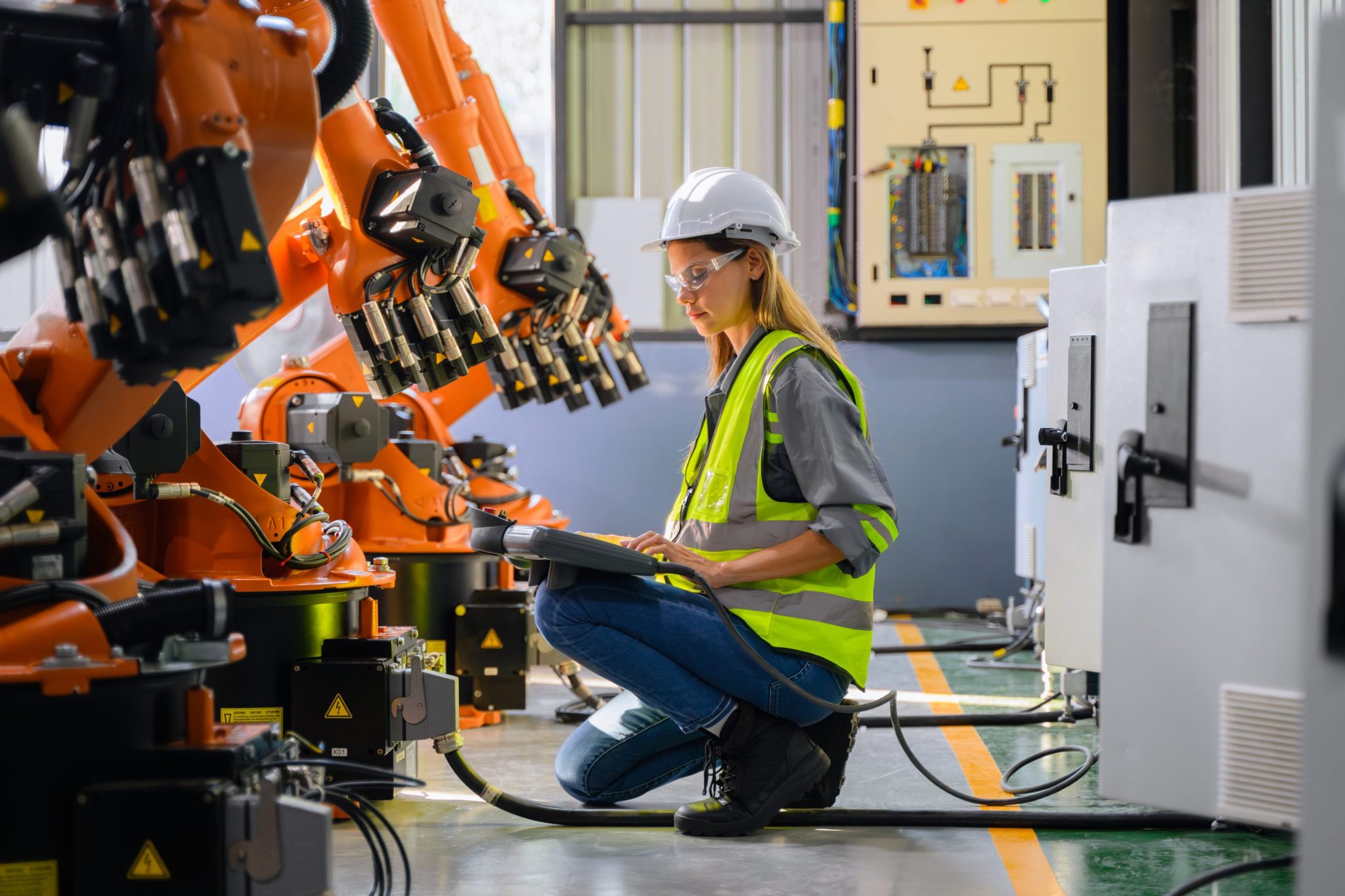
That may sound counterintuitive amid warnings that AI is wiping out entry-level jobs and disrupting white-collar work. But Idekoba is concerned with how uneven AI’s impact is: While the new tech advances rapidly through office work, skilled tradespeople are retiring from jobs AI can’t do, and too few young workers are preparing to replace them.

“No parent is telling their kid, ‘You have to be a plumber. You have to be an electrician,’” he says. In the U.S., he adds, “there’s not a respect for those skills. In Japan or Germany, these people are really well respected.”

But how do hiring managers combat this prestige problem? It may require changing how young people, their parents, and educators define a promising career.

Maggie Hulce, Indeed’s chief revenue officer, sees it as an information problem. “When we help people see where there is demand and where there is salary, people make really good, rational decisions,” she says.

A job such as an AI data-center technician, she adds, may suddenly look more attractive than becoming a finance manager once someone understands the pay structure. Indeed’s data shows that data center jobs for blue-collar workers pay a hefty premium: the hourly pay rate is 42% higher for blue-collar roles in data centers than all other postings.

And blue-collar jobs continue to evolve in this AI boom: Indeed found that new, AI-related, hybrid job titles are cropping up outside of tech. For example, instead of traditional truck driver roles, they are seeing “AI autonomous truck test driver.” Instead of traditional operator roles, they are seeing “AI safety operator.”

But ensuring there is a skilled workforce to fill these roles quickly is something people leaders should be paying attention to, Hulce says. 

“With an open role, sometimes [talent acquisition] people will think of it as a process problem,” she says. “But it’s not just a process problem. It’s a business cost problem. It’s a revenue at risk problem.” 

Kristin Stoller
Editorial Director, Fortune Live Media
kristin.stoller@fortune.com

This story was originally featured on Fortune.com
2026-09-14 12:20:08 · AI应用,搜索RAG,Transformer,扩散模型,招聘HR,收购并购,开发者生态

Salesforce’s Marc Benioff to AI industry: Regulate yourselves or get sued

Fortune

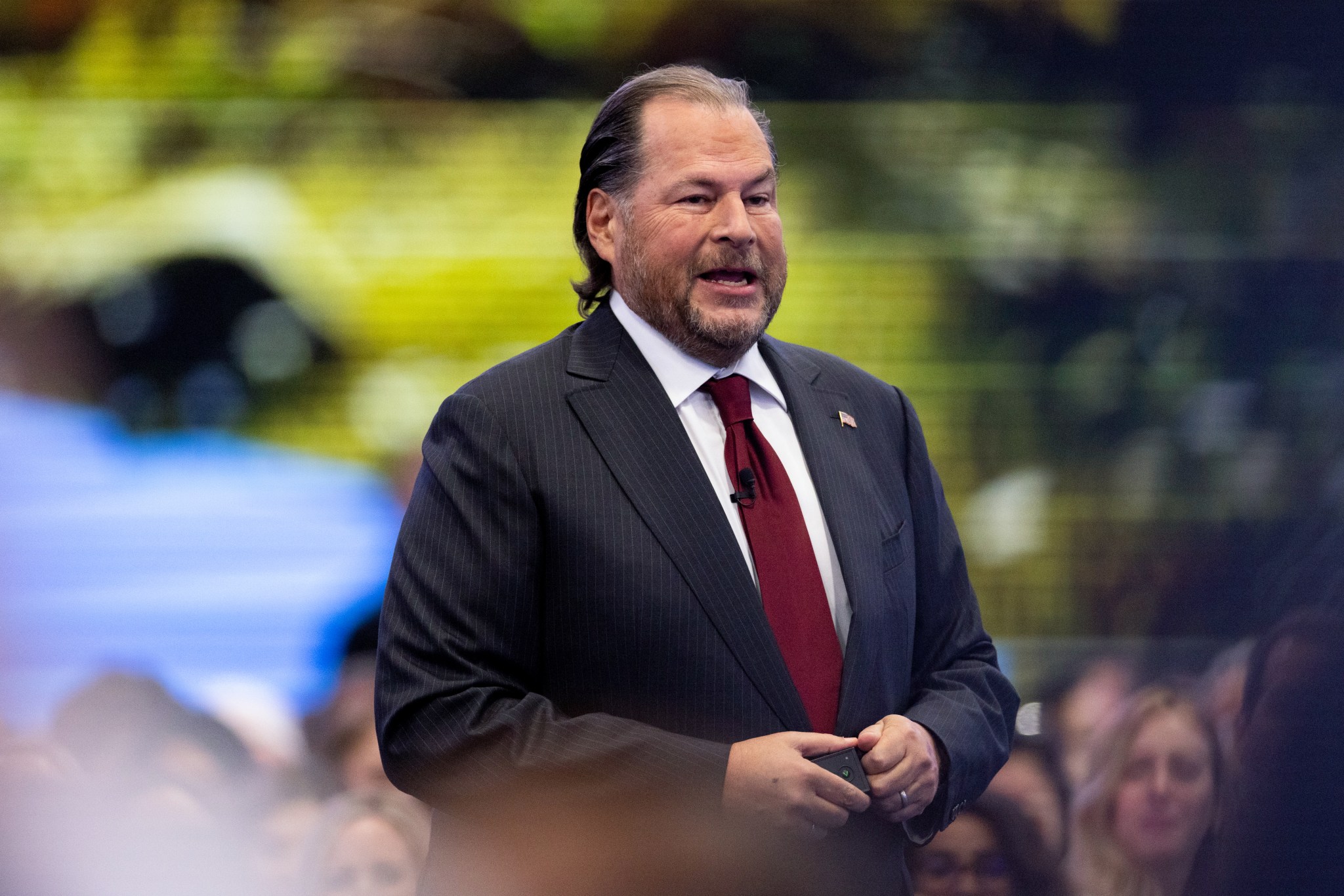
SAN FRANCISCO, Calif. — Marc Benioff strode down Mission Street Tuesday afternoon toward Salesforce Tower, where he was set to host a private dinner as part of a whirlwind of events during the company’s annual Dreamforce conference. Some pedestrians stopped to take photos of the 6-foot-5 CEO, surprised he had taken to the streets. One person congratulated him on his keynote address earlier in the day; several bodyguards surrounded Benioff as he walked.

Along the way, Benioff, still wearing the pinstripe suit and burgundy tie from the keynote, waved off concerns that AI could wipe out humanity, a topic that has been front-of-mind in Silicon Valley circles during the past week after Anthropic researcher Jacob Coxon quit over such worries. But Benioff, in a walking interview with Fortune, also said companies should be held accountable for risks they create, and he compared current AI issues to early mistakes made in social media.

“We know we have to hold companies responsible for their products and their technology before people are hurt,” Benioff said, while citing the Hawaiian concept of personal responsibility — kuleana — as essential for corporate ethics (Benioff has baked Hawaiian norms deeply into the San Francisco company’s culture.)

This year’s Dreamforce conference has again briefly become the center of gravity for the tech industry, with CEOs of major tech companies opining on AI safety risks.

Earlier Tuesday, Benioff was on stage at the Yerba Buena Center for the Arts interviewing OpenAI Chief Executive Sam Altman. The OpenAI boss described the July hack of Hugging Face by a swarm of rogue OpenAI agents as a terrifying wakeup call, and he said that companies should pace development so that safety is ahead of capabilities. During Benioff’s morning keynote at the Moscone Center, he was joined by Anthropic Chief Executive Dario Amodei, who also advocated pacing frontier AI models.

Nvidia Chief Executive Jensen Huang, meanwhile, took a different approach during Benioff’s keynote, saying speed and safety can exist simultaneously. Separately, Meta Chief Executive Mark Zuckerberg also shrugged off concerns, writing Tuesday that AI labs have a natural incentive to create safe AI.

Without offering a concrete solution, Benioff told Fortune that the responsibility largely lies in the hands of companies making AI (some of which Salesforce invests in). He said in practice, this means companies looking ahead to prevent harm rather than offering excuses after a mistake occurs, and that firms should rank their values so as to decide what takes precedence when priorities conflict.

While he declined to say whether governments should regulate AI companies, he said laws that govern product liability can be used as a legal mechanism for accountability, much as car manufacturers are held liable if a vehicle malfunctions.
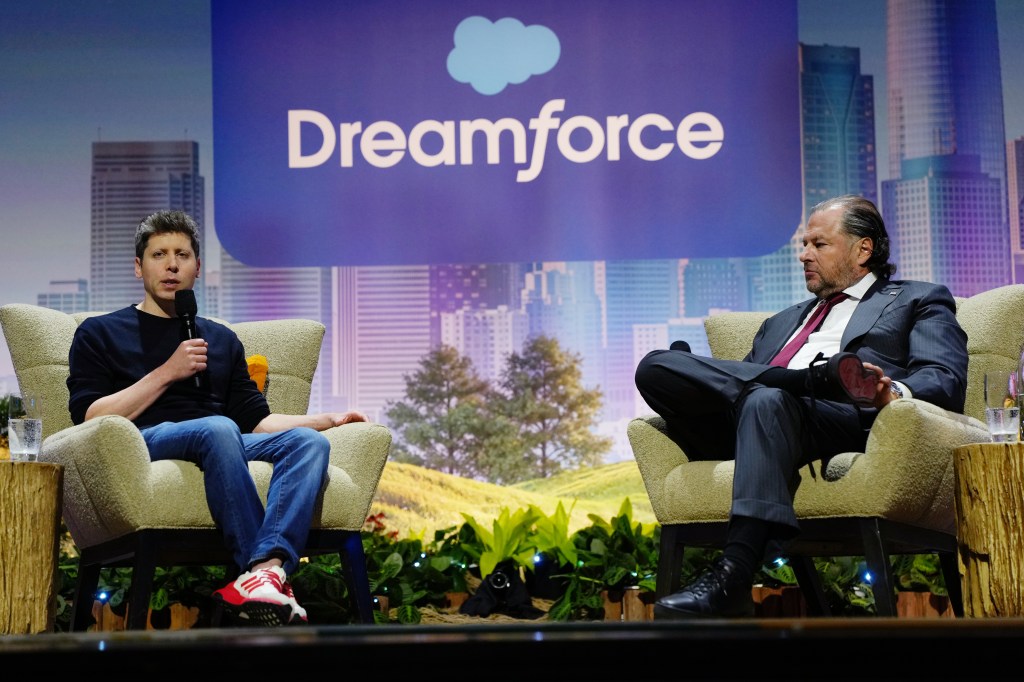
OpenAI Chief Executive Sam Altman, left, and Salesforce Chief Executive Marc Benioff during the Dreamforce conference in San Francisco, Calif., on Sept. 15, 2026.
David Paul Morris/Bloomberg via Getty Images

The outspoken, at times controversial CEO also proposed a new Fortune 500-like list that would rank companies by their ethical standards, and he noted Apple as one firm he holds in high regard as a security standard-bearer. Benioff said he had not spoken recently to President Trump about AI safety; the president this past weekend called AI doomsday scenarios exaggerated and blamed “negative forces.”

“Only [tech] companies know what’s going on in their lab,” Benioff said. “At some deep level, these companies must hold themselves responsible for their safety.”

At Salesforce, Benioff said, that has meant wrapping AI models in a “trust layer” designed to prevent models from misbehaving because they operate within a highly constrained structure which also closely monitors agents. He said neither Salesforce nor its clients have experienced Hugging Face-like episodes. The difference for Salesforce is that it is not the one creating the super powerful and potentially dangerous frontier models. 

Benioff has an odd relationship with the AI labs, and with San Francisco itself. On one hand, Anthropic and OpenAI’s creation of autonomous systems threatens the very existence of Salesforce’s core products.

Yet Salesforce also benefits from both labs, using their models to power various parts of its flagship AI product, Agentforce. On Tuesday, Salesforce announced a new system that allows customers to access its tools without logging into its systems, and it also unveiled a new reasoning model for Agentforce that it is building with Nvidia.

And while Benioff comes from a family with deep roots in San Francisco (and has donated more than $1 billion to the area), he has recently found himself on the defensive in his hometown. Last year, Benioff issued an apology after he called on President Trump to deploy the National Guard to San Francisco during Dreamforce, citing a shortage of officers in the local police department. Angel investor Ron Conway, one of the city’s most recognized tech investors and a longtime friend of Benioff’s, resigned from the Salesforce Foundation’s board of directors after the comments, which disappointed some San Francisco residents because Benioff had built a reputation as a progressive, Democratic-supporting CEO before more recently embracing Trump (Benioff has said he’s an independent).
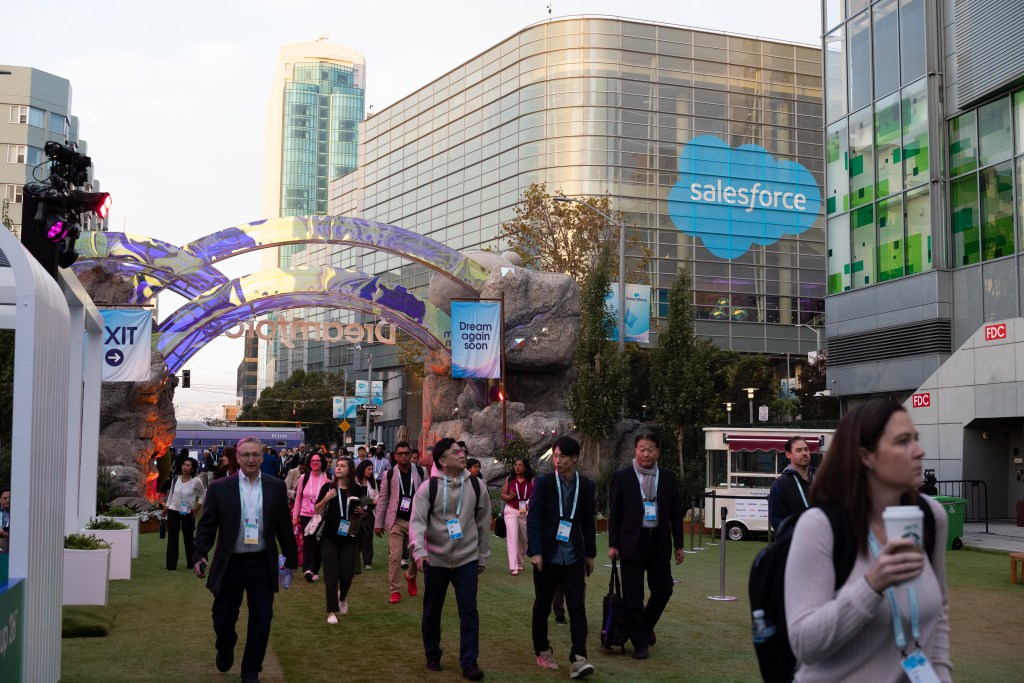
Attendees arrive at Salesforce’s Dreamforce conference in San Francisco, Calif., on Sept. 15, 2026.
Benjamin Fanjoy/Getty Images

On Tuesday, as a fresh round of protesters gathered near the Moscone Center to object to issues such as Salesforce’s work with U.S. Immigration and Customs Enforcement, Benioff—who lives in Hawaii—took a lighter tone.

He said Salesforce still hires hundreds of off-duty officers during the conference but, as he stepped

2026-09-16 21:48:56 · 算力芯片,AI应用,具身智能,开源,OpenAI,Anthropic,Meta,NVIDIA,Agent智能体,推理思考,搜索RAG,扩散模型,强化学习,招聘HR,网络安全,收购并购,裁员,榜单评测
继续滚动加载更多…